Actium: The Sea Battle That Made an Empire
Two fleets, one dying Republic, and a queen's ships slipping through the smoke — the day Rome's future was decided at sea.
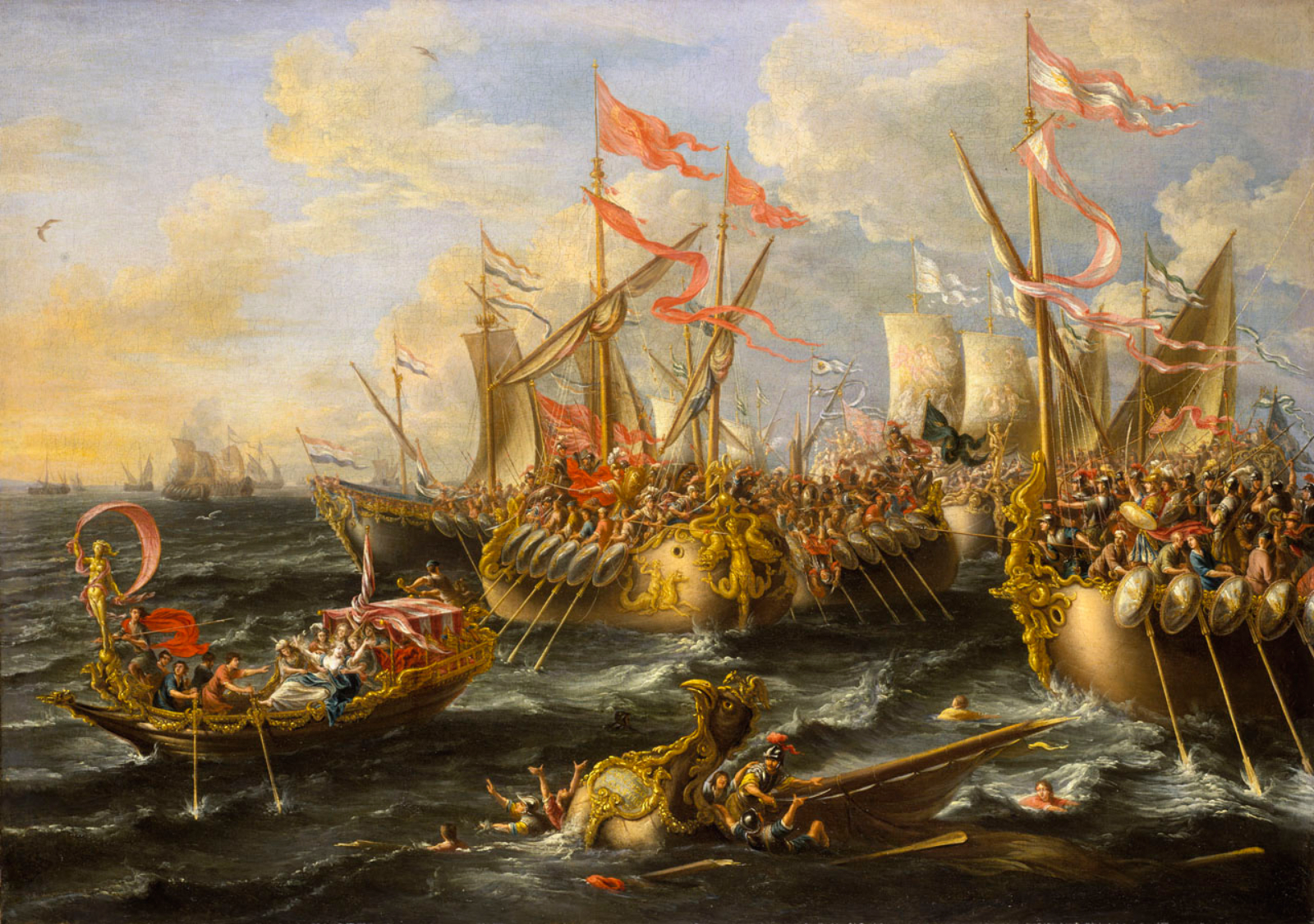
By early 31 BC, Mark Antony and Cleopatra were camped at Actium, on the western coast of Greece, commanding 500 ships and 70,000 infantry. To the north, Octavian arrived with 400 ships and 80,000 infantry, seizing Patrae and Corinth with the help of his admiral Marcus Vipsanius Agrippa, cutting Antony's line of communication with Egypt through the Peloponnese. What had begun as rivalry between two heirs of Julius Caesar's legacy had become a full blockade.
The roots of the conflict ran back to 44 BC, when Caesar's assassination left Octavian his adopted son and sole heir, while Antony, Caesar's most successful officer, held the loyalty of many veterans. Their uneasy partnership in the Second Triumvirate, alongside Lepidus, curdled as Antony left Octavian's sister Octavia Minor to join Cleopatra in Alexandria. In 34 BC, Antony and Cleopatra elevated her son Caesarion, then thirteen, to the title 'King of Kings' in the Donations of Alexandria — a direct affront to Roman tradition and to Octavian's claim as Caesar's only legitimate heir. Octavian answered with propaganda, accusing Antony of plotting a monarchy centered on Alexandria.
As the Second Triumvirate formally expired on the last day of 33 BC, Antony wrote to the Senate declining reappointment, hoping it would back him as its champion against Octavian's ambitions. Mutual accusations piled up: Octavian faulted Antony's presence in Egypt, his treatment of Sextus Pompeius, his betrayal of Armenia's king, and his bond with Cleopatra; Antony accused Octavian of overstepping his own powers. By 32 BC, a third of the Senate and both sitting consuls had thrown in with Antony.
War came to Greece. Agrippa crossed the Ionian Sea, captured the naval base at Methoni, drove Antony's forces from Corfu, and cleared the way for Octavian's army of 80,000 infantry and 12,000 cavalry to land unopposed and reach Toryne within days. Octavian's forces then encircled much of the enemy fleet gathered in the Ambracian Gulf near Actium. Caught off guard by the speed of Octavian's advance, Antony's army, cut off from resupply, suffered hunger and mounting desertions. His repeated offers of a land battle were refused.
Through the Greek summer, Actium's marshy climate spread sickness and plague through Antony's camp, while Octavian's men held healthy highland ground with steady supplies. Trapped in the gulf, Antony could not risk his ships to reposition his army, and the months-long siege bred desertions even among allied commanders — some real, some suspected, all met with executions on Antony's orders. Tensions flared too over Cleopatra's presence, some Romans wanting her sent away, others defending her role in the war.
More from History

The Morning Bingham Climbed to Machu Picchu
On a cold July morning in 1911, an American historian scrambled up a jungle-choked ridge above the Urubamba River — and by afternoon, a forgotten Inca citadel would belong to the world.

The Last Half-Hour of the Hindenburg
It was already half a day late, and the public had been told to keep away — but at seven o'clock that evening, the Hindenburg finally turned toward its mooring mast for the last time.

The Last Hours of Pompeii: August 24, 79 AD
By noon it was just another hot day beside the Bay of Naples. By evening, an entire mountain had rewritten the fate of thousands.

The Longest Walk: Mandela's Last Steps to Freedom
After 27 years behind bars, a 71-year-old man had to relearn how to walk out of a prison gate — into a waiting world of cameras, crowds, and a country holding its breath.

The Document Lincoln Signed on the First Day of 1863
On a single January morning, a president's pen would change the legal status of more than three million people — if the ink held and his hand did not shake.

The Day of the Dream: August 28, 1963
Two hundred and fifty thousand people converged on the National Mall that morning — by nightfall, one voice from the steps of the Lincoln Memorial would echo for generations.