Agincourt: The Knights Drowned in Mud
A ragged English army, sick and outnumbered nearly three to one, faced annihilation on a French field. By nightfall, it was the flower of French nobility that lay dead in the mud.
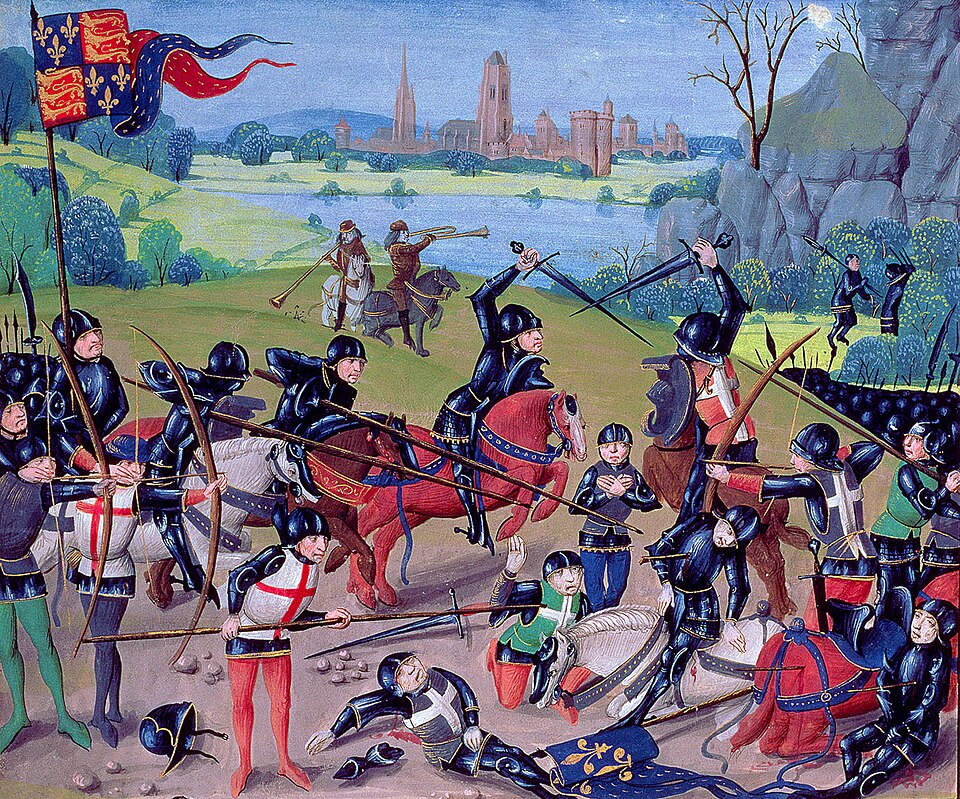
On the morning of 25 October 1415, Saint Crispin's Day, King Henry V of England surveyed a battlefield that seemed to promise disaster. His force, roughly 9,000 men, had already been battered by disease during the long siege of Harfleur and a punishing march toward Calais. Blocking their path near the village of Azincourt stood a French army of more than 30,000, commanded not by King Charles VI — incapacitated by mental illness — but by Constable Charles d'Albret and a coterie of Armagnac noblemen.
The negotiations that had preceded this moment had collapsed months earlier. Henry claimed the French throne through his great-grandfather Edward III, though English kings had usually been willing to trade that claim for territory and money. He had demanded 1.6 million crowns owed from King John II's old ransom, ownership of Anjou, Brittany, Flanders, Normandy, Touraine, and Aquitaine, and marriage to Charles VI's daughter Catherine with a two-million-crown dowry. The French offered far less. By April 1415, Henry's Great Council sanctioned war, and in August his fleet landed in Normandy.
The siege of Harfleur, which fell on 22 September, cost the English dearly in time and health. Rather than sail home after capturing a single town, Henry marched some 9,000 men toward Calais — partly to assert his claim to Normandy by his very presence, partly as a challenge to the dauphin, who had ignored his call to personal combat. The French, gathering near Rouen, moved to cut him off.
The ground the French chose to fight on became their undoing. Squeezed between two patches of woodland, the field was too narrow for their numbers, forcing men into cramped, suffocating ranks. October rains had turned it into a swamp; knights dismounting from their horses sank nearly to their knees in mud, their armor now a burden rather than a shield. Henry pushed his own army to the tightest point of the field and readied a defense few French commanders anticipated: rows of sharpened stakes driven into the earth by his archers, a barrier against cavalry charge.
Nearly 80 percent of Henry's army were English and Welsh longbowmen, and it was their weapon that decided the day. As French cavalry attempted to overrun the archers' flanks and their dismounted knights advanced through the churned mud toward the center, the stakes, the narrow ground, and a relentless hail of arrows turned the French assault into chaos. By the day's end, the outnumbered English had won an overwhelming victory.
More from History

The Morning Bingham Climbed to Machu Picchu
On a cold July morning in 1911, an American historian scrambled up a jungle-choked ridge above the Urubamba River — and by afternoon, a forgotten Inca citadel would belong to the world.

The Last Half-Hour of the Hindenburg
It was already half a day late, and the public had been told to keep away — but at seven o'clock that evening, the Hindenburg finally turned toward its mooring mast for the last time.

The Last Hours of Pompeii: August 24, 79 AD
By noon it was just another hot day beside the Bay of Naples. By evening, an entire mountain had rewritten the fate of thousands.

The Longest Walk: Mandela's Last Steps to Freedom
After 27 years behind bars, a 71-year-old man had to relearn how to walk out of a prison gate — into a waiting world of cameras, crowds, and a country holding its breath.

The Document Lincoln Signed on the First Day of 1863
On a single January morning, a president's pen would change the legal status of more than three million people — if the ink held and his hand did not shake.

The Day of the Dream: August 28, 1963
Two hundred and fifty thousand people converged on the National Mall that morning — by nightfall, one voice from the steps of the Lincoln Memorial would echo for generations.