Athens, 1896: The Games Wake From a 1,500-Year Sleep
On a spring morning in Athens, a French pedagogue's stubborn dream and a Greek athlete's dusty run through Marathon collided to revive something the world had buried for fifteen centuries.
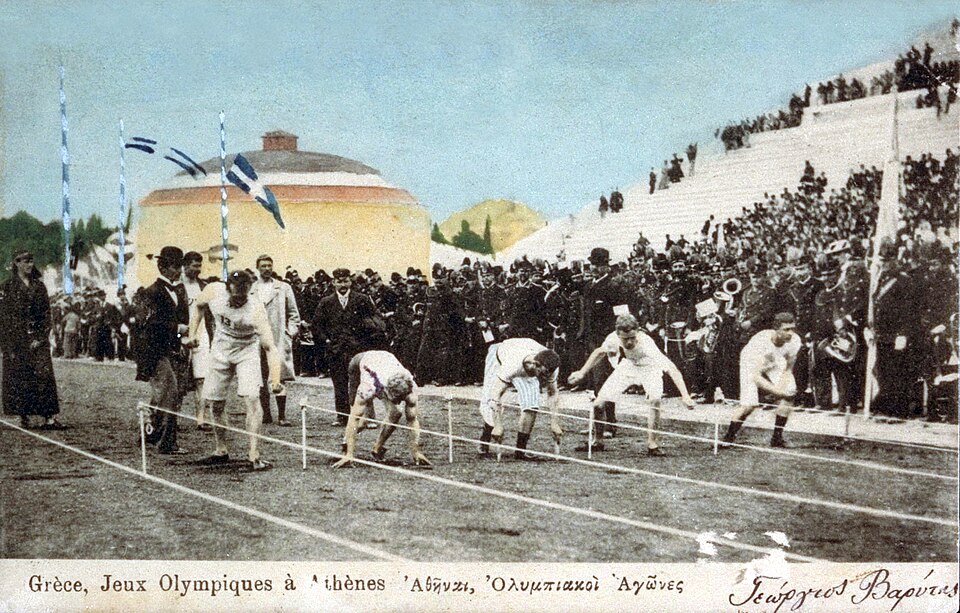
On 6 April 1896, in a marble stadium overflowing with spectators, an American athlete named James Connolly leapt into the sand pit for the triple jump and, in doing so, became the first Olympic medalist in more than 1,500 years. It was a moment nobody in the crowd could fully grasp yet: the ancient Olympic Games, extinguished centuries earlier, had just been reborn as something entirely new — an international, modern spectacle.
The idea had been gathering force for decades. Small sports festivals inspired by antiquity had popped up across 19th-century Europe, including the 1870 Olympics at a refurbished Panathenaic stadium that drew 30,000 spectators. In England, physician William Penny Brookes had been running the Wenlock Olympian Games since 1850. In Greece, businessman Evangelis Zappas had organized his own Olympics in 1859, 1870 and 1875. It was a French historian, Pierre de Coubertin, who fused these threads into a single vision: a multinational, multi-sport festival for the modern age.
Coubertin's plan crystallized on 18 June 1894, when he organized a congress at the Sorbonne in Paris to present his ideas to delegates from eleven countries; the congress itself ran on through 23 June. There, delegates agreed to create the International Olympic Committee and to hold the first modern Games — not in 1900, as Coubertin first proposed alongside the Paris Universal Exposition, but in 1896, out of fear that a longer wait would dull public enthusiasm. The choice of host city was murkier. Some delegates favored London, but after a private conversation with Greek representative Demetrius Vikelas, Coubertin proposed Athens instead. Since Greece was the ancient home of the Olympics, the congress approved it unanimously on 23 June, and Vikelas became the IOC's first president.
Greece, however, was in no shape to host anything grand. The country was politically unstable, with the premiership swinging between Charilaos Trikoupis and Theodoros Deligiannis, and a report by Stefanos Skouloudis warned that costs would run triple Coubertin's estimate. Skouloudis resigned rather than proceed. It was Crown Prince Constantine, taking over the organizing committee in January 1895, who rescued the project — raising roughly 300,000 drachmas in public donations, 400,000 from special commemorative postage stamps, and 200,000 from ticket sales. The legacies of Evangelis Zappas and his cousin Konstantinos Zappas were folded in too, and businessman George Averoff personally covered the stadium's marble reconstruction, a gift honored with a statue unveiled outside the venue on 5 April 1896.
When the Games opened on 6 April in the rebuilt Panathenaic Stadium, athletes stood grouped by nation on the infield while nine bands and a 150-voice choir performed an Olympic Hymn composed by Spyridon Samaras with lyrics by Kostis Palamas. Crown Prince Constantine delivered a speech before his father, King George, formally declared the Games open. Fourteen nations and 241 male athletes competed — more than 65% of them Greek — making it the largest international sporting gathering the world had yet seen.
More from History

The Morning Bingham Climbed to Machu Picchu
On a cold July morning in 1911, an American historian scrambled up a jungle-choked ridge above the Urubamba River — and by afternoon, a forgotten Inca citadel would belong to the world.

The Last Half-Hour of the Hindenburg
It was already half a day late, and the public had been told to keep away — but at seven o'clock that evening, the Hindenburg finally turned toward its mooring mast for the last time.

The Last Hours of Pompeii: August 24, 79 AD
By noon it was just another hot day beside the Bay of Naples. By evening, an entire mountain had rewritten the fate of thousands.

The Longest Walk: Mandela's Last Steps to Freedom
After 27 years behind bars, a 71-year-old man had to relearn how to walk out of a prison gate — into a waiting world of cameras, crowds, and a country holding its breath.

The Document Lincoln Signed on the First Day of 1863
On a single January morning, a president's pen would change the legal status of more than three million people — if the ink held and his hand did not shake.

The Day of the Dream: August 28, 1963
Two hundred and fifty thousand people converged on the National Mall that morning — by nightfall, one voice from the steps of the Lincoln Memorial would echo for generations.