Atlantis: The Island Plato Sank to Make a Point
A philosopher spins a tale of a lost empire drowned by the gods overnight — and 2,400 years later, treasure hunters are still combing the ocean floor for it.
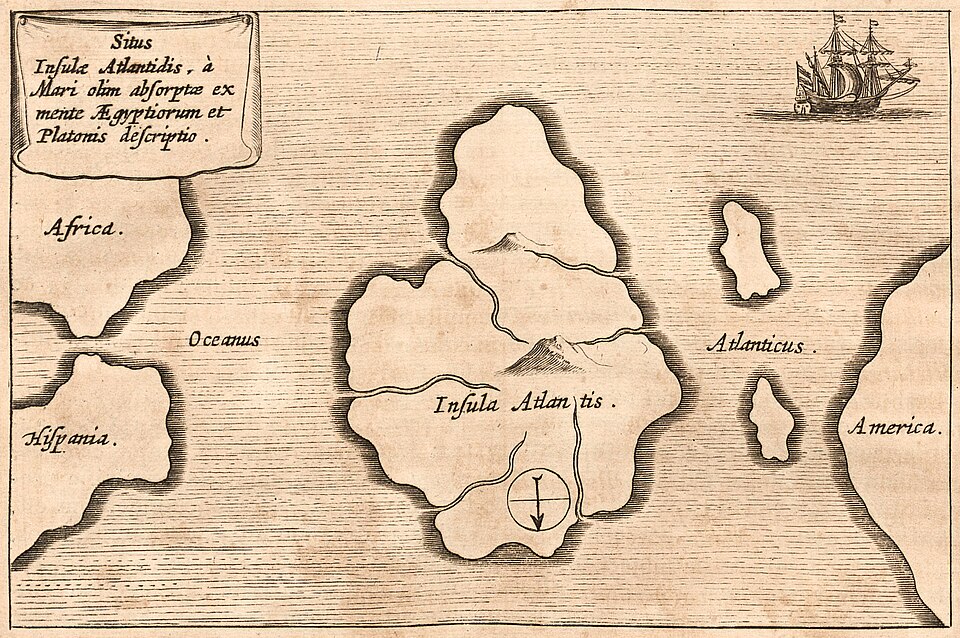
In 360 BC, in the dialogue Timaeus, Plato set down words that would launch a hunt lasting millennia. He wrote of a mighty host that had come from a distant point in the Atlantic Ocean, larger than Libya and Asia combined, lying just beyond the Pillars of Heracles — the strait we now call Gibraltar. This island, he said, had once commanded a confederation of kings so powerful it held sway not only over itself but over many other islands and lands beyond.
The story appears in only two places: Plato's Timaeus and its unfinished sequel, Critias. Every later mention of Atlantis in Western thought traces back to these two texts. In them, Critias claims to be relaying a tale passed down from his grandfather Dropides, who heard it from the poet Solon, who in turn was told it by Egyptian priests during a visit to Egypt between 590 and 580 BC. According to that same chain of storytelling, the priests dated the events of Atlantis to roughly 9,000 years before Solon's own time — placing them, within Plato's fictional chronology, around 9500 BC. The chain of storytellers, and the vague dating it carries, is itself part of the fiction's careful construction.
According to Critias, the Greek gods once divided the earth among themselves, and Poseidon received Atlantis as his portion. There he fell in love with a mortal woman named Cleito, daughter of Evenor and Leucippe, and fathered five pairs of twin sons. The eldest, Atlas, became the island's first king — and gave Atlantis its name, 'island of Atlas.' Plato described the land in precise, almost bureaucratic detail: mountainous to the north, and in the south a vast plain measuring roughly 555 kilometers in one direction and 370 in the other, with a central island just under a kilometer across.
But Atlantis's power, in Plato's telling, curdled into hubris. The island launched a campaign against a fictionalized version of ancient Athens — the very Athens Plato imagined as his ideal state from the Republic. The campaign failed, the gods withdrew their favor, and Atlantis sank beneath the ocean in a single catastrophic night, leaving behind, Plato says, only an impassable mud shoal that made the sea beyond impossible to navigate.
Plato's intent was never historical. Scholars overwhelmingly agree the story was an allegory, contrasting a naval empire from the west with the Achaemenid Empire that ruled the east, and holding up Athens as proof of the superiority of Plato's ideal state. He was known to freely invent or borrow parables to illustrate philosophical points, much as he did with the tale of Gyges. Some researchers suspect faint echoes of real events bled into the tale — the eruption of Thera, the invasions of the Sea Peoples, the Trojan War, or even contemporary disasters like Athens's failed invasion of Sicily in 415–413 BC and the sudden destruction of the city of Helike in 373 BC.
More from History

The Morning Bingham Climbed to Machu Picchu
On a cold July morning in 1911, an American historian scrambled up a jungle-choked ridge above the Urubamba River — and by afternoon, a forgotten Inca citadel would belong to the world.

The Last Half-Hour of the Hindenburg
It was already half a day late, and the public had been told to keep away — but at seven o'clock that evening, the Hindenburg finally turned toward its mooring mast for the last time.

The Last Hours of Pompeii: August 24, 79 AD
By noon it was just another hot day beside the Bay of Naples. By evening, an entire mountain had rewritten the fate of thousands.

The Longest Walk: Mandela's Last Steps to Freedom
After 27 years behind bars, a 71-year-old man had to relearn how to walk out of a prison gate — into a waiting world of cameras, crowds, and a country holding its breath.

The Document Lincoln Signed on the First Day of 1863
On a single January morning, a president's pen would change the legal status of more than three million people — if the ink held and his hand did not shake.

The Day of the Dream: August 28, 1963
Two hundred and fifty thousand people converged on the National Mall that morning — by nightfall, one voice from the steps of the Lincoln Memorial would echo for generations.