Chan Chan: The Adobe Capital of the Chimú
In a desert where rain almost never falls, a civilization built the largest city of pre-Columbian South America out of mud — and filled it with gold worth millions.
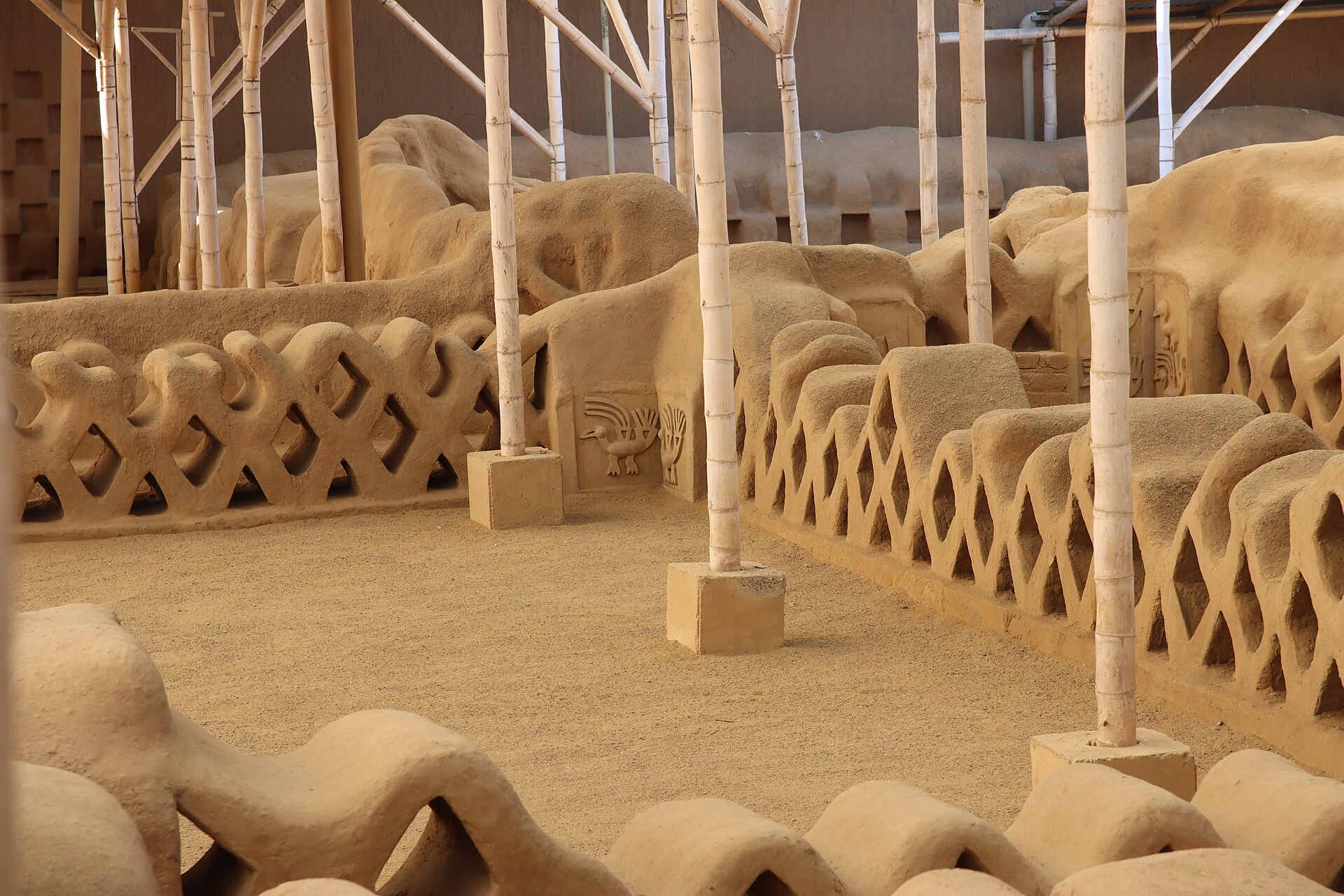
Five kilometers west of modern Trujillo, Peru, the sand-colored ruins of Chan Chan sprawl across the mouth of the Moche Valley, a silent testament to an empire that once rivaled the Inca. Built around 850 AD by the Chimú, Chan Chan served as the capital of Chimor from 900 to 1470, a conquest state that developed from the Chimú culture, which had established itself along the Peruvian coast around 900 CE. At its height, this was the largest city in pre-Columbian South America, home to an estimated 40,000 to 60,000 people.
Water should never have allowed a city like this to exist. Chan Chan sits in one of the most arid stretches of Peru's coastal desert, where rainfall is virtually nonexistent. The Chimú solved this by harnessing river runoff flowing down from the Andes, channeling it through irrigation systems that let them control both land and water in a landscape that offered neither freely.
The city itself covered 20 square kilometers, with a dense urban core of 6 square kilometers packed with extravagant ciudadelas — walled compounds of astonishing architectural ambition. These weren't ordinary neighborhoods; they held plazas, storerooms, and burial platforms reserved for royalty, their splendor marking them as spaces of the ruling class. Ordinary residents, many of them artisans producing crafts for the empire, lived in far humbler quarters known as small, irregular agglutinated rooms, which often doubled as workshops.
The very name Chan Chan has puzzled linguists for generations. It first appears in written form as 'Cauchan' in the 1536 founding document of Trujillo's town council, with the stable spelling 'Chanchan' only emerging in records from the mid-1600s onward. Scholars have proposed wildly different origins — one claim tied it fancifully to a word for 'snake,' another to 'moon,' and a more serious hypothesis from Ernst Middendorf linked it to a Mochica word for 'sun.' But current linguists rule out that Mochica origin entirely: Matthias Urban leans toward an origin in the lost Quingnam language once spoken in the Chimor kingdom, while Rodolfo Cerrón-Palomino argues for a Quechua root meaning 'corral' or 'fenced place.' Neither has convinced the other, and the true meaning remains unresolved.
More from History

The Morning Bingham Climbed to Machu Picchu
On a cold July morning in 1911, an American historian scrambled up a jungle-choked ridge above the Urubamba River — and by afternoon, a forgotten Inca citadel would belong to the world.

The Last Half-Hour of the Hindenburg
It was already half a day late, and the public had been told to keep away — but at seven o'clock that evening, the Hindenburg finally turned toward its mooring mast for the last time.

The Last Hours of Pompeii: August 24, 79 AD
By noon it was just another hot day beside the Bay of Naples. By evening, an entire mountain had rewritten the fate of thousands.

The Longest Walk: Mandela's Last Steps to Freedom
After 27 years behind bars, a 71-year-old man had to relearn how to walk out of a prison gate — into a waiting world of cameras, crowds, and a country holding its breath.

The Document Lincoln Signed on the First Day of 1863
On a single January morning, a president's pen would change the legal status of more than three million people — if the ink held and his hand did not shake.

The Day of the Dream: August 28, 1963
Two hundred and fifty thousand people converged on the National Mall that morning — by nightfall, one voice from the steps of the Lincoln Memorial would echo for generations.