Crimea: The War That Rehearsed Modern Warfare
A dying empire, a squabble over church keys in Jerusalem, and a naval massacre at Sinop — together they dragged four great powers into a war fought with railways, telegraphs, and photographs for the first time in history.
In the autumn of 1853, the world watched an old order groan under its own weight. The Ottoman Empire, once feared across Europe, had spent decades losing ground — Serbia's autonomy in 1804, Greek independence in 1830, Egypt's defiant vassal Muhammad Ali nearly toppling Constantinople in the early 1830s. Contemporaries began calling it the 'sick man of Europe,' and Tsar Nicholas I of Russia looked at the patient with the eyes of an heir rather than a physician.
The spark, oddly, was a dispute over holy sites in Jerusalem. France, self-appointed protector of Catholics in the Ottoman Empire, and Russia, protector of the Orthodox, both pressed for privileges over Christian shrines. Nicholas seized on the disagreement to demand that all Orthodox subjects of the Sultan fall under his protection — a demand the Ottomans, backed by British assurances, refused. Russian troops crossed into the Danubian Principalities of Moldavia and Wallachia in July 1853 without a formal declaration of war, and the Sultan, pressed by his own outraged public, declared war on Russia that October.
Britain and France watched Russian expansion with real alarm. London worried that a Russian breakthrough toward the Mediterranean would threaten the route to India; Paris saw a chance to reclaim continental prestige and perhaps needle Russia over Poland. Vienna hosted a conference to broker peace, but it went nowhere. Then, on 30 November 1853, the Russian fleet annihilated an Ottoman naval squadron off Sinop, and the shock of that destruction turned European public opinion decisively against St Petersburg.
By March 1854, Britain and France had issued Russia an ultimatum — withdraw from the principalities, respect Ottoman sovereignty, drop the protectorate claim — and receiving no answer, declared war on 12 March 1854. Austria, though it did not fight, pressured Russia diplomatically and secured the evacuation of the Danubian provinces. Russia's advance was checked at Silistria that June, and the allies, having secured the Balkan front, turned their sights south, toward Russia's Black Sea stronghold of Sevastopol in Crimea.
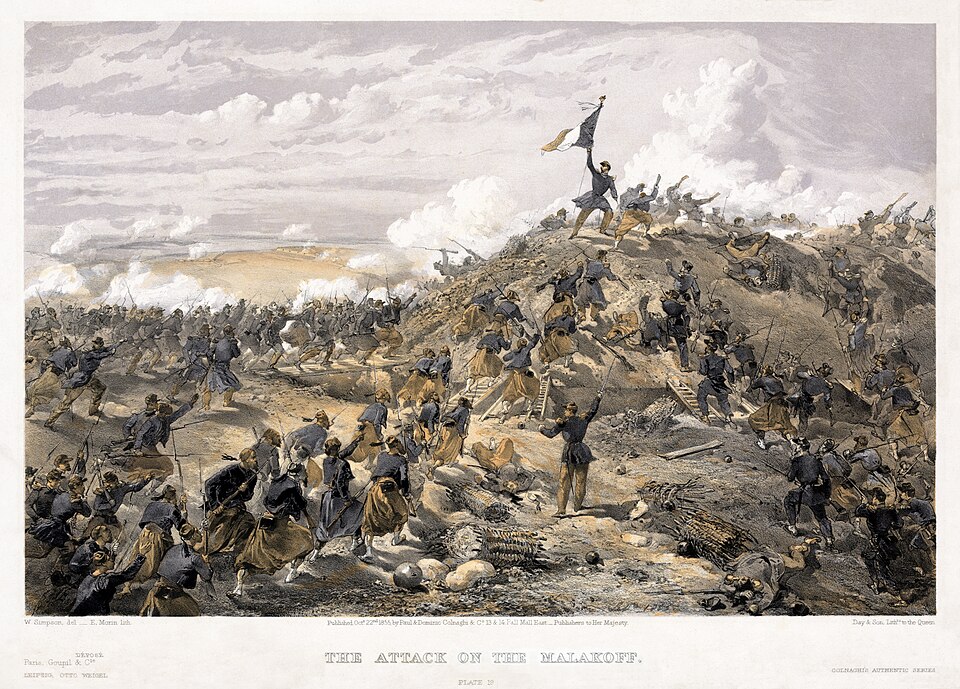
The allied landing in September 1854 opened a brutal new chapter. Victory at the Alma gave the invaders early momentum, and Russian counterattacks at Balaclava and Inkerman that autumn were both repulsed, though at fearful cost on every side. What followed was not a swift campaign but an eleven-month siege of Sevastopol, fought through winter cold, disease, and supply failures that killed as many soldiers as combat did. Sardinia-Piedmont joined the allied cause in 1855, lending its own troops to the trenches around the city.
More from History

The Morning Bingham Climbed to Machu Picchu
On a cold July morning in 1911, an American historian scrambled up a jungle-choked ridge above the Urubamba River — and by afternoon, a forgotten Inca citadel would belong to the world.

The Last Half-Hour of the Hindenburg
It was already half a day late, and the public had been told to keep away — but at seven o'clock that evening, the Hindenburg finally turned toward its mooring mast for the last time.

The Last Hours of Pompeii: August 24, 79 AD
By noon it was just another hot day beside the Bay of Naples. By evening, an entire mountain had rewritten the fate of thousands.

The Longest Walk: Mandela's Last Steps to Freedom
After 27 years behind bars, a 71-year-old man had to relearn how to walk out of a prison gate — into a waiting world of cameras, crowds, and a country holding its breath.

The Document Lincoln Signed on the First Day of 1863
On a single January morning, a president's pen would change the legal status of more than three million people — if the ink held and his hand did not shake.

The Day of the Dream: August 28, 1963
Two hundred and fifty thousand people converged on the National Mall that morning — by nightfall, one voice from the steps of the Lincoln Memorial would echo for generations.