Great Zimbabwe: The Stone City Africa Built and Colonizers Denied
Its walls rose eleven meters without a drop of mortar — and for decades, colonial officials insisted Africans couldn't have built it.
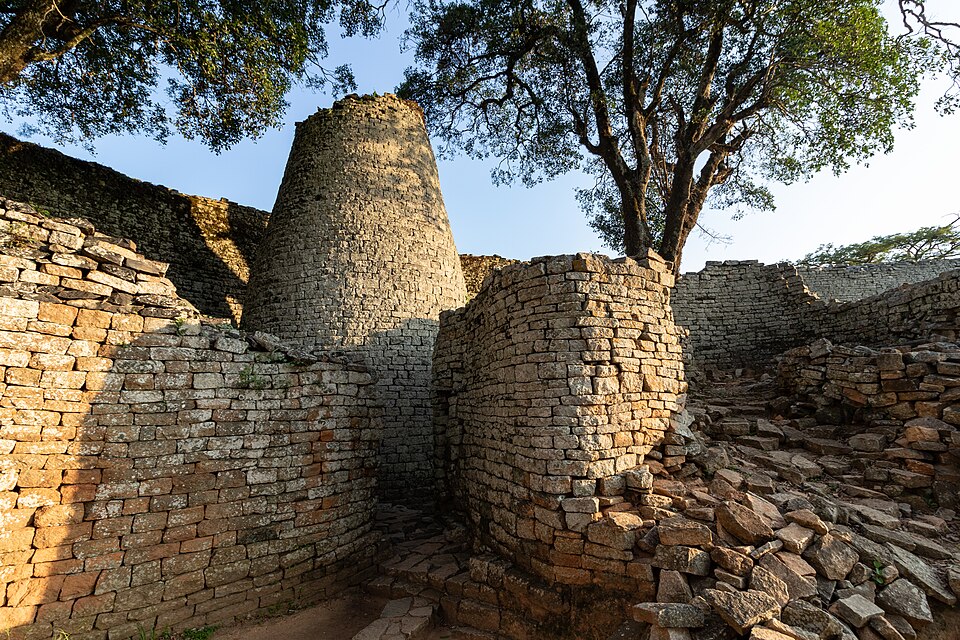
Deep in the hills of southeastern Zimbabwe, near the modern town of Masvingo, granite walls curve across the landscape like the ribs of some ancient, sleeping animal. No mortar binds these stones together — just the precision of hands that fitted rock to rock so tightly that the structures have outlasted centuries of rain, sun, and empire. This is Great Zimbabwe, the largest stone structure built in precolonial Southern Africa, and for a time, the beating heart of a kingdom that stretched across roughly 50,000 square kilometers.
The land itself had been inhabited far longer than the stones suggest. San peoples lived in the region for 100,000 years, and Bantu-speaking farmers arrived around 150 BCE, eventually forming agricultural chiefdoms by the 4th century CE. Communities of the Gokomere and Ziwa cultures worked iron and farmed the valley, but they built nothing in stone. It was their descendants, the Gumanye people — ancestors of the Karanga branch of the Shona — who began, around 1000 CE, the slow work of settlement that would eventually rise into a city.
Construction of the great stone buildings began in the 11th century and continued into the 15th century. Cattle and agriculture built the social bonds that held communities together, while long-distance trade transformed local chiefdoms into something larger and more centralized. As the ruling dynasty grew wealthy, they built thick daga-walled houses and screened themselves from public view behind rising stone walls — a physical expression of a widening gap between rulers and ruled. By the 13th century, this process had accelerated dramatically, and the city we recognize today began to take shape as the capital of the Kingdom of Great Zimbabwe. Its most famous structure, the Great Enclosure, was itself raised specifically during the 13th and 14th centuries, layered atop the older Hill Complex.
That structure still stuns visitors with walls reaching 11 meters high and stretching some 250 meters in length. Scholars debate exactly what purpose it served, but many believe it was a royal residence, with spaces set aside for ritual and public ceremony. In the Hill Complex, a shrine likely served as home to spirit mediums called svikiro, tasked with acting as the conscience of the state and preserving the memory of the kingdom's founders — figures such as Chigwagu Rusvingo, said to be the first mambo, or king.
At its height, Great Zimbabwe may have housed as many as 18,000 to 20,000 people, though a more recent statistical analysis of the archaeological and historical evidence suggests the true number likely never exceeded 10,000. Either way, the city sprawled across roughly 7.22 square kilometers — an area comparable to medieval London — encompassing the Hill Complex, the Valley Complex, and the Great Enclosure, along with housing for ordinary residents within the perimeter walls.
More from History

The Morning Bingham Climbed to Machu Picchu
On a cold July morning in 1911, an American historian scrambled up a jungle-choked ridge above the Urubamba River — and by afternoon, a forgotten Inca citadel would belong to the world.

The Last Half-Hour of the Hindenburg
It was already half a day late, and the public had been told to keep away — but at seven o'clock that evening, the Hindenburg finally turned toward its mooring mast for the last time.

The Last Hours of Pompeii: August 24, 79 AD
By noon it was just another hot day beside the Bay of Naples. By evening, an entire mountain had rewritten the fate of thousands.

The Longest Walk: Mandela's Last Steps to Freedom
After 27 years behind bars, a 71-year-old man had to relearn how to walk out of a prison gate — into a waiting world of cameras, crowds, and a country holding its breath.

The Document Lincoln Signed on the First Day of 1863
On a single January morning, a president's pen would change the legal status of more than three million people — if the ink held and his hand did not shake.

The Day of the Dream: August 28, 1963
Two hundred and fifty thousand people converged on the National Mall that morning — by nightfall, one voice from the steps of the Lincoln Memorial would echo for generations.