Kosovo Field, 1389: The Day Two Rulers Fell
On a plain in the Balkans, a sultan was murdered in his own tent and a prince bled out with him — and an empire's fate, and a nation's myth, were both born in the same afternoon.
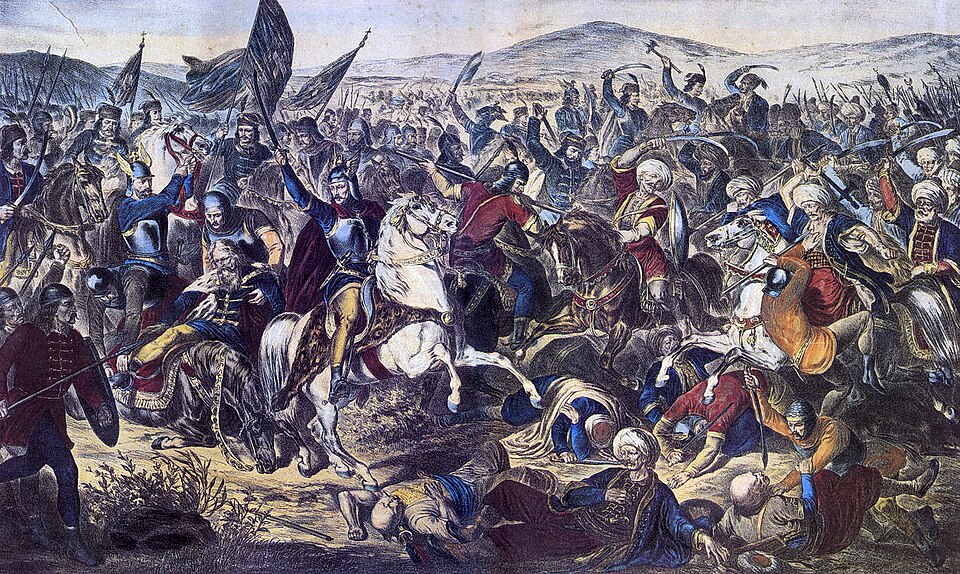
In mid-June 1389, two armies converged on a broad plain northwest of what is now Pristina. On one side stood Sultan Murad I, commander of the Ottoman Empire, marching with troops from Kütahya, Hamid, and other Anatolian provinces. On the other stood Prince Lazar Hrebeljanović, ruler of Moravian Serbia and the most powerful of the fractured Serbian lords, backed by a multi-ethnic Christian coalition that included forces sent by Vuk Branković and a Bosnian contingent under Vlatko Vuković, dispatched by King Tvrtko I.
The road to that field had been long. After the death of Tsar Stefan Dušan in 1355, and the childless death of his weak successor Uroš V in 1371, the Serbian Empire had splintered into rival principalities just as the Ottomans pressed westward. Ottoman setbacks and victories alike — a defeat at Pločnik in 1387, and fighting near Bileća in 1388 — had emboldened a fragile Balkan alliance of Serbs, Bosnians, and others even as Murad's forces marched from Philippoupolis through Ihtiman, Kratovo, and Pristina, arriving on 14 June 1389.
Lazar, gathering his own troops near Niš, moved to Kosovo once he learned of Murad's approach, choosing ground that let him block every route the sultan might take. What followed on the field, fought around 15 June (with 28 June — St Vitus's Day, or Vidovdan — later marked as the commemorative date), is one of history's most poorly documented major battles. No firsthand account from a participant survives, and the two traditions that formed afterward — Ottoman and Serbian — diverge sharply in nearly every detail, including the size of the armies. Western scholarship generally estimates Lazar's force at 15,000–20,000 against an Ottoman army of 27,000–30,000, though some Ottoman chroniclers, writing generations later, inflated the Christian coalition to absurd levels to magnify the glory of the Turkish victory.
What is agreed upon is the outcome: both armies were largely destroyed, and both of their supreme commanders died. Lazar was killed. Murad was assassinated — the only time in history an Ottoman sultan died in battle. Serbian accounts, including a letter from Bosnian King Tvrtko I to the Trogir senate and later a Florentine council response dated 20 October 1389, describe a group of twelve knights who broke through the Ottoman lines and camel-chain barricade to reach Murad's tent, one of them delivering the fatal blow. Ottoman tradition names the killer as Miloš Obilić, a Serbian noble who reportedly approached the sultan as if to kiss his hand and pledge conversion to Islam, then struck him down with a hidden blade. Among the dead was also Pal Kastrioti of the Albanian Catholic Kastrioti family. Murad's internal organs were buried on the battlefield itself; his body was carried back to Bursa for burial.
News of a sultan's death on a foreign field spread quickly across Europe, and in the first rumors it was this fact — not who had actually won — that dominated conversation. Yet the practical consequences fell hardest on the Serbs. Lazar's widow, Milica, took the regency of Moravian Serbia for their son Stefan Lazarević, and was soon compelled to send her youngest daughter, Mileva Olivera Lazarević, as a bride to the new Ottoman sultan, Bayezid I — a peace offering sealed in marriage. Serbian manpower, badly depleted, could no longer field armies capable of resisting future Ottoman campaigns, which drew on fresh reserves from Anatolia.
More from History

The Morning Bingham Climbed to Machu Picchu
On a cold July morning in 1911, an American historian scrambled up a jungle-choked ridge above the Urubamba River — and by afternoon, a forgotten Inca citadel would belong to the world.

The Last Half-Hour of the Hindenburg
It was already half a day late, and the public had been told to keep away — but at seven o'clock that evening, the Hindenburg finally turned toward its mooring mast for the last time.

The Last Hours of Pompeii: August 24, 79 AD
By noon it was just another hot day beside the Bay of Naples. By evening, an entire mountain had rewritten the fate of thousands.

The Longest Walk: Mandela's Last Steps to Freedom
After 27 years behind bars, a 71-year-old man had to relearn how to walk out of a prison gate — into a waiting world of cameras, crowds, and a country holding its breath.

The Document Lincoln Signed on the First Day of 1863
On a single January morning, a president's pen would change the legal status of more than three million people — if the ink held and his hand did not shake.

The Day of the Dream: August 28, 1963
Two hundred and fifty thousand people converged on the National Mall that morning — by nightfall, one voice from the steps of the Lincoln Memorial would echo for generations.