Lydia: The Kingdom That Invented Money
Long before banks or paper bills, a small Anatolian kingdom pressed lumps of gold-and-silver alloy into some of the oldest coins ever minted — and then built an empire on the idea.
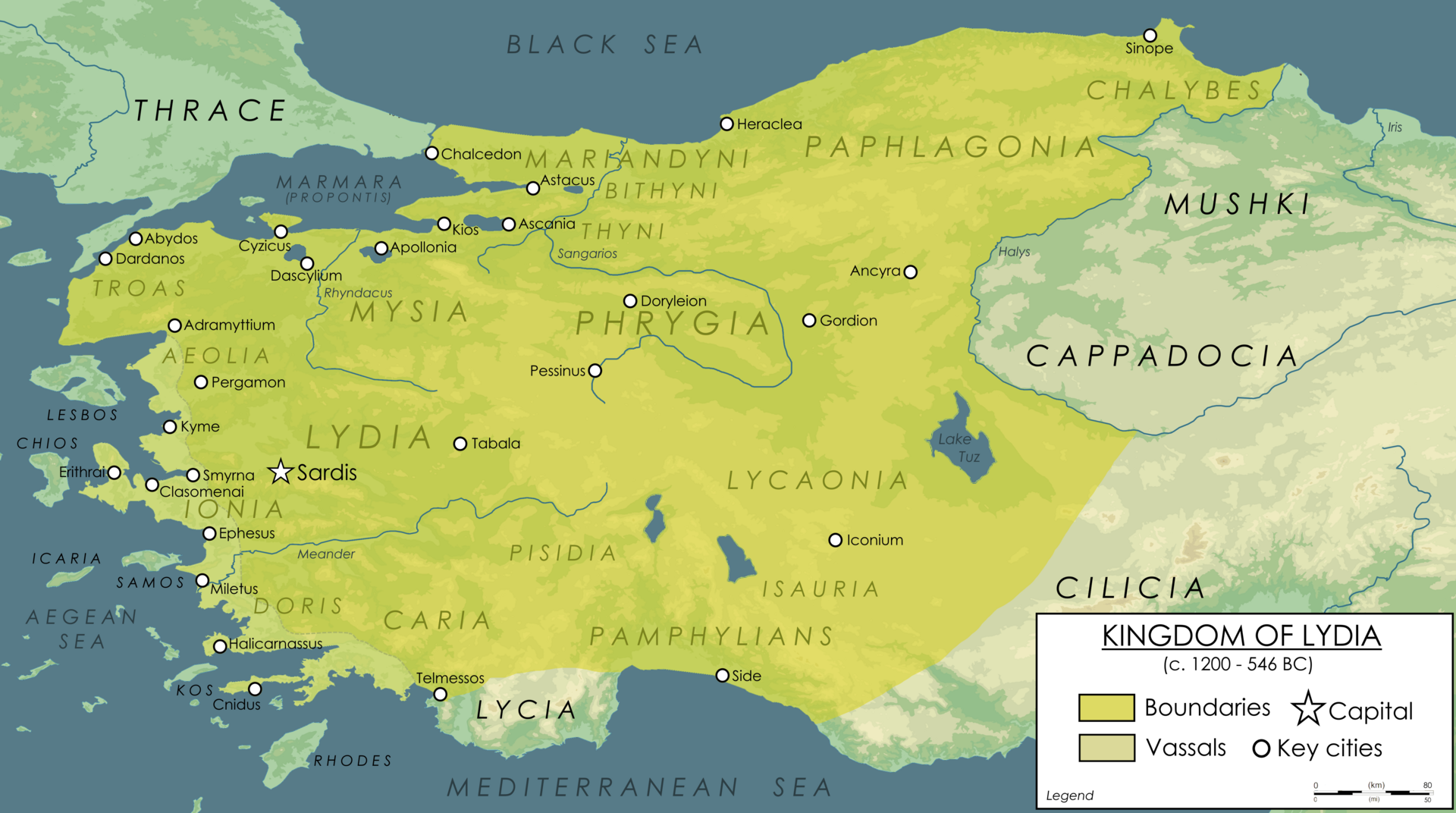
On the banks of the Gediz River in western Anatolia stood Sardis, capital of a kingdom whose name would echo through history for one deceptively simple invention: money. Lydia emerged from the shadowy legacy of the Bronze Age Arzawa lands, absorbing older sub-kingdoms like Mira and Šeḫa and the city that would become Ephesus. By around 800 BC the Lydian people had achieved a rough political cohesion, though the earliest chapters of their story survive mostly as myth rather than record.
Herodotus tells of a legendary line, the Heraclids, said to rule for twenty-two generations, ending with a king named Candaules who died around 687 BC. History proper begins with Gyges, the first Lydian king whose existence rests on contemporary evidence rather than legend. He seized the throne from Candaules with help from a Carian prince, Arselis of Mylasa, amid the chaos following Cimmerian invasions that had just destroyed the once-dominant kingdom of Phrygia.
Gyges turned crisis into opportunity. He built Lydia into a military power, sent diplomats to the Assyrian court at Nineveh seeking help against the Cimmerians, and struck at the Greek cities of Miletus, Smyrna, and Colophon. His alliances with Carian rulers even let him send Carian and Ionian mercenaries across the sea to aid the Egyptian king Psamtik I, who used that help around 662 BC to unify Egypt under his own rule.
But the Cimmerians were not finished. In 644 BC they struck a third time, led by King Lygdamis. Sardis was sacked, and Gyges himself was killed. His son Ardys took the throne, kept up the Assyrian diplomacy, and captured the city of Priene from Miletus — a prize Lydia would hold until its very end. Yet in 637 BC, disaster returned: the Thracian Treres, allied with Cimmerians and Lycians, invaded, and Ardys likely died fighting them.
His son Sadyattes ruled only briefly before dying in 635 BC, probably also fighting the relentless Cimmerian threat that had plagued three generations of Lydian kings. It was Sadyattes's son Alyattes who finally broke the cycle, transforming Lydia into a genuine empire. Allied with Assyria, he welcomed Scythian forces under King Madyes, who drove the Treres out of Anatolia and crushed the Cimmerians for good — ending decades of devastation.
More from History

The Morning Bingham Climbed to Machu Picchu
On a cold July morning in 1911, an American historian scrambled up a jungle-choked ridge above the Urubamba River — and by afternoon, a forgotten Inca citadel would belong to the world.

The Last Half-Hour of the Hindenburg
It was already half a day late, and the public had been told to keep away — but at seven o'clock that evening, the Hindenburg finally turned toward its mooring mast for the last time.

The Last Hours of Pompeii: August 24, 79 AD
By noon it was just another hot day beside the Bay of Naples. By evening, an entire mountain had rewritten the fate of thousands.

The Longest Walk: Mandela's Last Steps to Freedom
After 27 years behind bars, a 71-year-old man had to relearn how to walk out of a prison gate — into a waiting world of cameras, crowds, and a country holding its breath.

The Document Lincoln Signed on the First Day of 1863
On a single January morning, a president's pen would change the legal status of more than three million people — if the ink held and his hand did not shake.

The Day of the Dream: August 28, 1963
Two hundred and fifty thousand people converged on the National Mall that morning — by nightfall, one voice from the steps of the Lincoln Memorial would echo for generations.