Nine Days to the Sea: The Great Offensive of 1922
At dawn on a hillside called Kocatepe, three men watched their guns speak first — and within two weeks an army of a hundred thousand would walk three hundred kilometers to the sea.
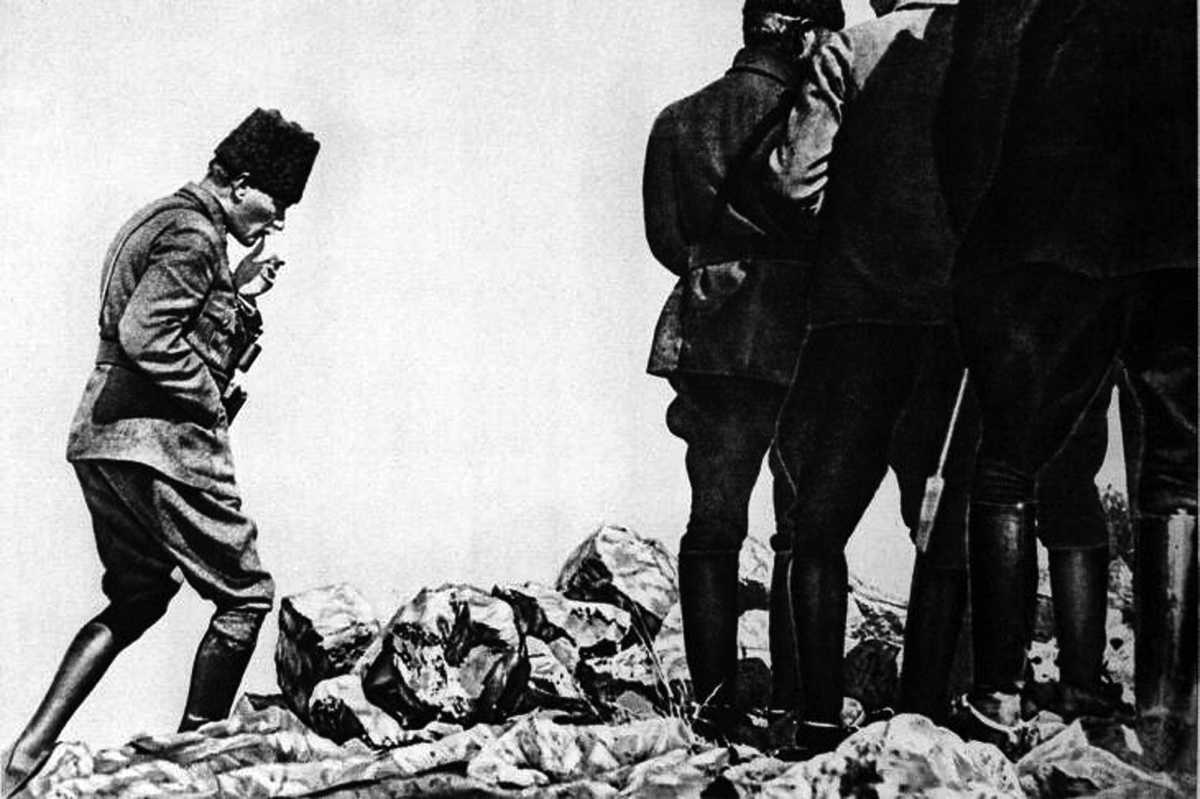
Before sunrise on 26 August 1922, Mustafa Kemal Atatürk climbed to a position known as Kocatepe with his Chief of Staff, Fevzi Paşa, and the Western Front commander, İsmet Paşa. Below them lay the Greek defensive lines that had held for nearly a year, running from the Gulf of Gemlik through Bilecik, Eskişehir, and the eastern approaches of Afyonkarahisar down to the Aegean along the Büyük Menderes River. The Turkish army had spent a year rebuilding after the Battle of the Sakarya, pulling troops from quiet eastern and southern fronts, stretching every financial resource, and even receiving smuggled weapons from sympathetic societies in occupied Istanbul. Even so, the Turks fielded around 98,000 men against a Greek force of roughly 130,000 — the largest Turkish concentration of the entire war, but still not a clear numerical advantage except in cavalry.
The plan was built on surprise and encirclement. The First Army would strike north from southwest of Afyonkarahisar, while the Second Army, positioned east and north of the city, would prevent the Greeks from shifting reinforcements and draw enemy reserves toward itself near Döğer. The 5th Cavalry Corps was tasked with crossing the Ahır Mountains to strike the Greek flanks and rear, severing the telegraph and rail links to İzmir. On the night of 26 August, that cavalry corps slipped through an unguarded position called Ballıkaya and spent the night moving deep behind Greek lines.
The assault itself opened with artillery bombardment at 4:30 that morning, intensifying against key points by five. By six, Turkish infantry had reached Tınaztepe, cutting through wire under bayonet before seizing it, and by nine they had taken Belentepe and then Kalecik-Sivrisi. On that first day alone, the First Army captured the Greek front-line positions across a fifteen-kilometer stretch from Büyük Kaleciktepe to Çiğiltepe. This opening clash became known as the Battle of Dumlupınar, and within four days it had broken the Greek army's ability to hold its ground.
What followed was a pursuit unlike anything the war had seen. The Turkish army had no motorized transport — its logistics depended on ox carts, infantry, and cavalry alone — yet from 31 August to 9 September the front moved 300 kilometers as Greek forces retreated in increasing disorder. On 29 August, Nikolaos Trikoupis, commander-in-chief of Greek forces in Asia Minor, surrendered. The main Turkish force pushed toward İzmir while a secondary force moved from Eskişehir toward Bursa. By 7 September, Aydın, Germencik, and Kuşadası had fallen.
More from History

The Morning Bingham Climbed to Machu Picchu
On a cold July morning in 1911, an American historian scrambled up a jungle-choked ridge above the Urubamba River — and by afternoon, a forgotten Inca citadel would belong to the world.

The Last Half-Hour of the Hindenburg
It was already half a day late, and the public had been told to keep away — but at seven o'clock that evening, the Hindenburg finally turned toward its mooring mast for the last time.

The Last Hours of Pompeii: August 24, 79 AD
By noon it was just another hot day beside the Bay of Naples. By evening, an entire mountain had rewritten the fate of thousands.

The Longest Walk: Mandela's Last Steps to Freedom
After 27 years behind bars, a 71-year-old man had to relearn how to walk out of a prison gate — into a waiting world of cameras, crowds, and a country holding its breath.

The Document Lincoln Signed on the First Day of 1863
On a single January morning, a president's pen would change the legal status of more than three million people — if the ink held and his hand did not shake.

The Day of the Dream: August 28, 1963
Two hundred and fifty thousand people converged on the National Mall that morning — by nightfall, one voice from the steps of the Lincoln Memorial would echo for generations.