Nine-Forty in the Fog: The Morning a Bomber Struck the Empire State Building
A Saturday fog swallowed Manhattan's skyline whole — and inside it, a bomber pilot lost his bearings with fatal speed.
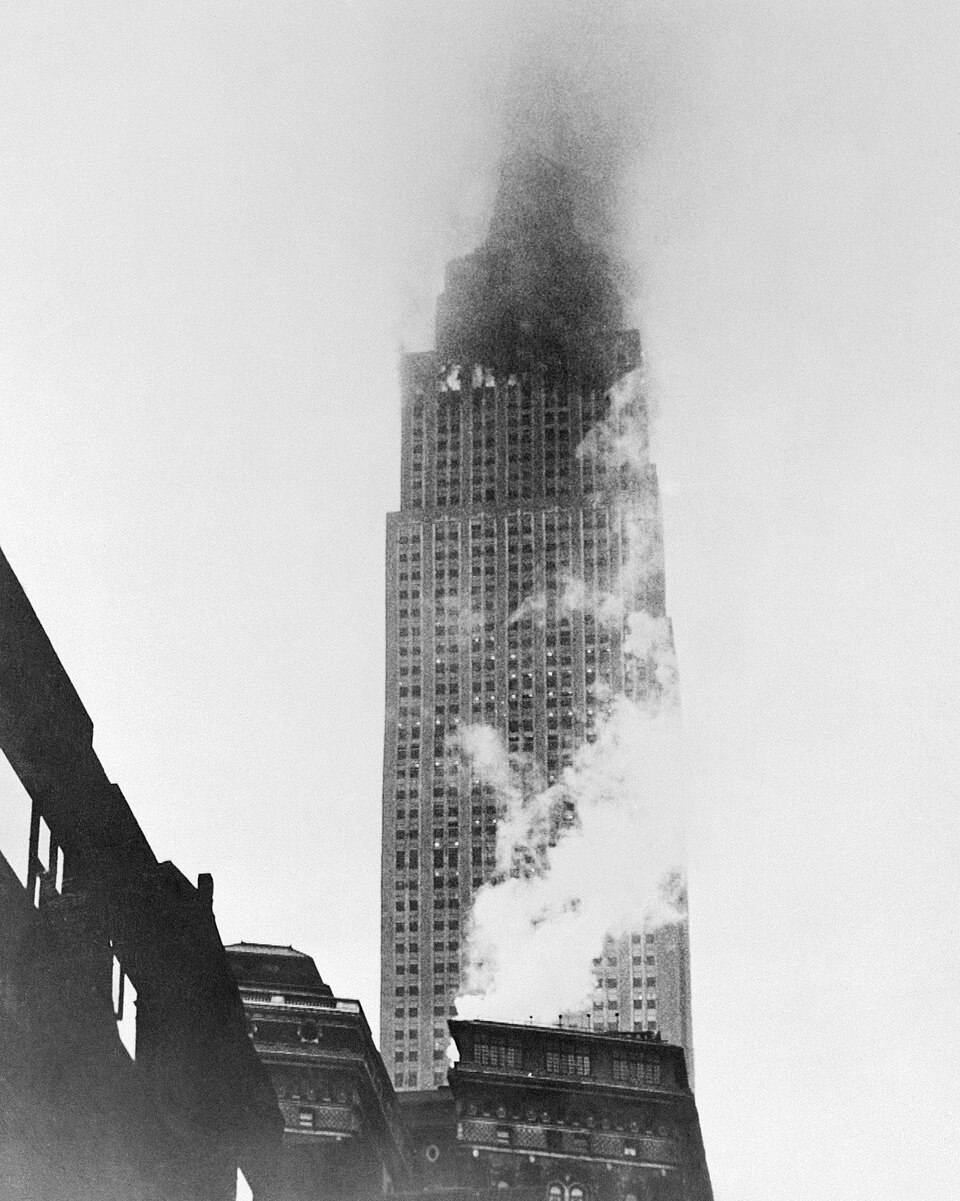
On the morning of Saturday, July 28, 1945, thick fog draped over New York City, blurring the tops of even its tallest towers. Lieutenant Colonel William Franklin Smith Jr., of Watertown, Massachusetts, was flying a B-25 Mitchell bomber on a routine personnel transport mission out of Bedford Army Air Field. The weather made a scheduled landing at LaGuardia Airport impossible, so Smith requested to divert to Newark Metropolitan Airport in New Jersey instead.
Air traffic control warned him of zero visibility, but Smith pressed on regardless. Flying blind through the gray shroud over Manhattan, he came dangerously close to the Chrysler Building near East 42nd Street. Disoriented, he turned right instead of left — a small, catastrophic misjudgment that sent the bomber on a collision course with another skyscraper looming ahead in the mist.
At 9:40 a.m., the B-25 slammed into the north side of the Empire State Building, tearing into the structure between the 78th and 80th floors. The impact carved an 18-by-20-foot hole into the offices of the War Relief Services and the National Catholic Welfare Council. One engine tore straight through the building and shot out the opposite side, traveling as far as the next block before dropping 900 feet onto a nearby rooftop, igniting a fire that destroyed a penthouse art studio.
The other engine, along with part of the landing gear, plunged down an elevator shaft, severing its cables. Fire broke out immediately inside the building, fed by aviation fuel, but firefighters brought it under control within 40 minutes — still remembered as the highest structural fire ever extinguished by New York's fire department.
Upstairs, between 50 and 60 sightseers stood on the 86th floor observation deck when the crash shook the tower. Fourteen people died that morning: Smith, Staff Sergeant Christopher Domitrovich, Aviation Machinist's Mate Albert Perna — who had been hitching a ride — and eleven civilians inside the building. Perna's body would not be recovered for two days, found at the bottom of an elevator shaft. Between 20 and 24 others were injured in the chaos.
More from History

The Morning Bingham Climbed to Machu Picchu
On a cold July morning in 1911, an American historian scrambled up a jungle-choked ridge above the Urubamba River — and by afternoon, a forgotten Inca citadel would belong to the world.

The Last Half-Hour of the Hindenburg
It was already half a day late, and the public had been told to keep away — but at seven o'clock that evening, the Hindenburg finally turned toward its mooring mast for the last time.

The Last Hours of Pompeii: August 24, 79 AD
By noon it was just another hot day beside the Bay of Naples. By evening, an entire mountain had rewritten the fate of thousands.

The Longest Walk: Mandela's Last Steps to Freedom
After 27 years behind bars, a 71-year-old man had to relearn how to walk out of a prison gate — into a waiting world of cameras, crowds, and a country holding its breath.

The Document Lincoln Signed on the First Day of 1863
On a single January morning, a president's pen would change the legal status of more than three million people — if the ink held and his hand did not shake.

The Day of the Dream: August 28, 1963
Two hundred and fifty thousand people converged on the National Mall that morning — by nightfall, one voice from the steps of the Lincoln Memorial would echo for generations.