Petra: The Rose City the Desert Almost Kept Secret
A nomadic desert people carved a capital into solid rock — then vanished so completely the West forgot Petra existed for over a thousand years.
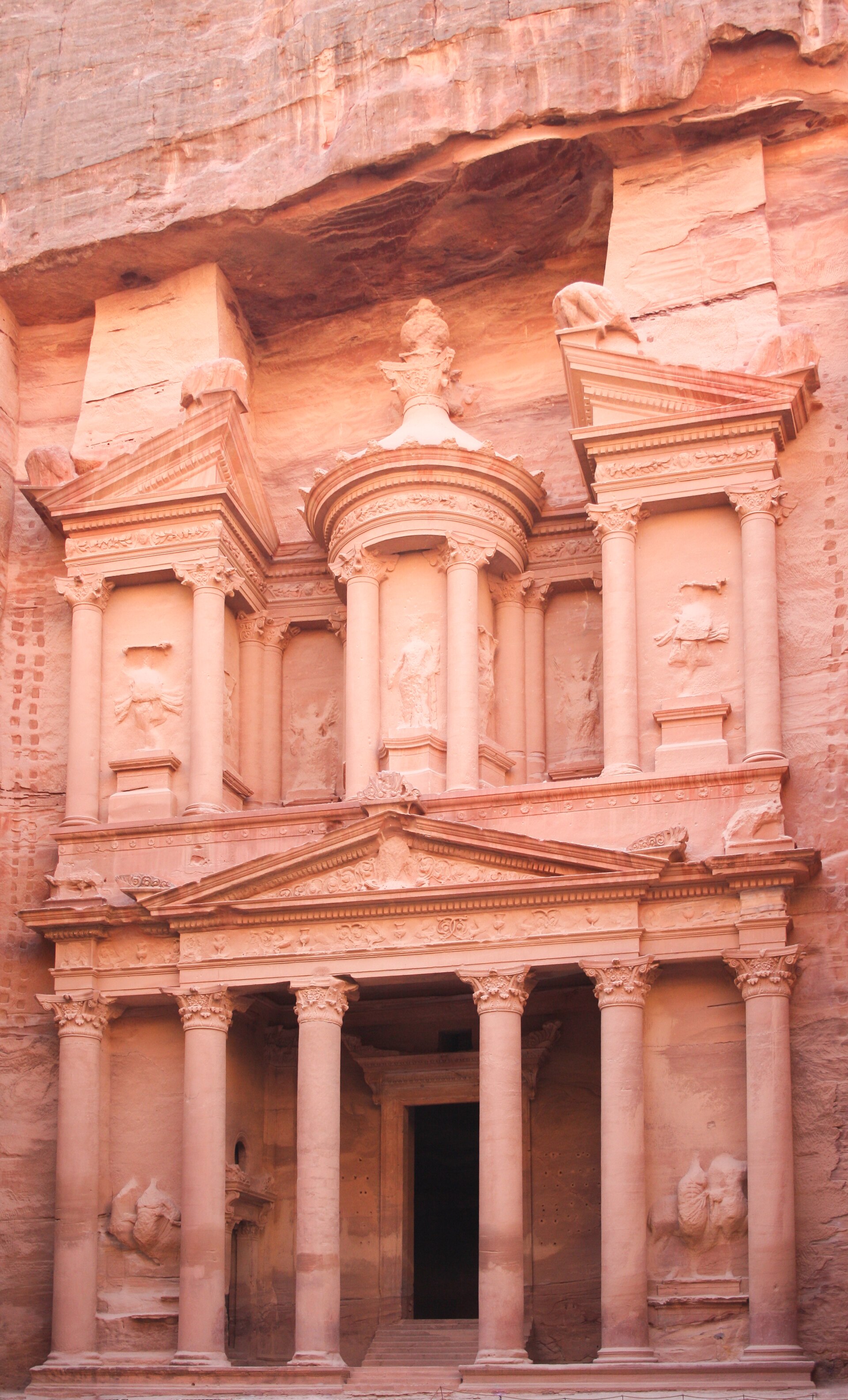
Long before the Nabataeans arrived, the ground beneath Petra had already seen millennia of human life. As early as 7000 BC, some of the world's earliest farmers settled at Beidha, just north of the site, and by the Iron Age, between 1200 and 600 BC, the Edomites occupied the area, drawn by a natural configuration of mountains that trapped water in a landscape with almost none to spare. That water made Petra a stopping point for merchants trading wine, olive oil, and wood — a role the city would inherit and magnify for centuries to come.
Into this landscape, in the 4th century BC, came the Nabataeans, a nomadic Arab people who moved with their herds across the Arabian Desert wherever pasture and water allowed. Though once thought to have Aramean roots, modern archaeological, religious, and linguistic evidence instead identifies them as a northern Arabian tribe. They called their city Raqmu — rendered in inscriptions as rqmw or rqm — a name later Hellenized by the Greeks into Petra, meaning simply 'Rock'.
What set the Nabataeans apart was not just where they settled but how they mastered it. Where rival powers struggled against the desert, the Nabataeans thrived in it, developing highly efficient systems for collecting rainwater and practicing desert agriculture that let them survive — and defend — their arid stronghold. By the 2nd century BC, Petra had become the capital of the Nabataean Kingdom, its position astride the incense trade routes turning it into a major regional trading hub and a considerable source of wealth.
That wealth reached its zenith in the 1st century AD, when Petra's population is estimated to have peaked at around 20,000 inhabitants. It was likely during this golden era that Al-Khazneh, possibly the mausoleum of the Nabataean king Aretas IV, was carved into the rose-colored sandstone cliffs — the structure that would one day become the city's most iconic image.
But Nabataean independence could not last forever. In 106 AD, under the governorship of Aulus Cornelius Palma Frontonianus, Rome absorbed the kingdom into its empire, renaming the region Arabia Petraea. The native dynasty ended, yet the city itself did not immediately wither — under Roman rule, engineers built the Petra Roman Road, and the city continued to flourish, reaching what many describe as the height of its splendor under Severus Alexander a century later.
More from History

The Morning Bingham Climbed to Machu Picchu
On a cold July morning in 1911, an American historian scrambled up a jungle-choked ridge above the Urubamba River — and by afternoon, a forgotten Inca citadel would belong to the world.

The Last Half-Hour of the Hindenburg
It was already half a day late, and the public had been told to keep away — but at seven o'clock that evening, the Hindenburg finally turned toward its mooring mast for the last time.

The Last Hours of Pompeii: August 24, 79 AD
By noon it was just another hot day beside the Bay of Naples. By evening, an entire mountain had rewritten the fate of thousands.

The Longest Walk: Mandela's Last Steps to Freedom
After 27 years behind bars, a 71-year-old man had to relearn how to walk out of a prison gate — into a waiting world of cameras, crowds, and a country holding its breath.

The Document Lincoln Signed on the First Day of 1863
On a single January morning, a president's pen would change the legal status of more than three million people — if the ink held and his hand did not shake.

The Day of the Dream: August 28, 1963
Two hundred and fifty thousand people converged on the National Mall that morning — by nightfall, one voice from the steps of the Lincoln Memorial would echo for generations.