Sarıkamış: The Army That Vanished in the Snow
In the last days of 1914, an army of 90,000 men marched into the Caucasian mountains chasing a bold plan. Within days, most of them would be dead — not from bullets, but from cold.
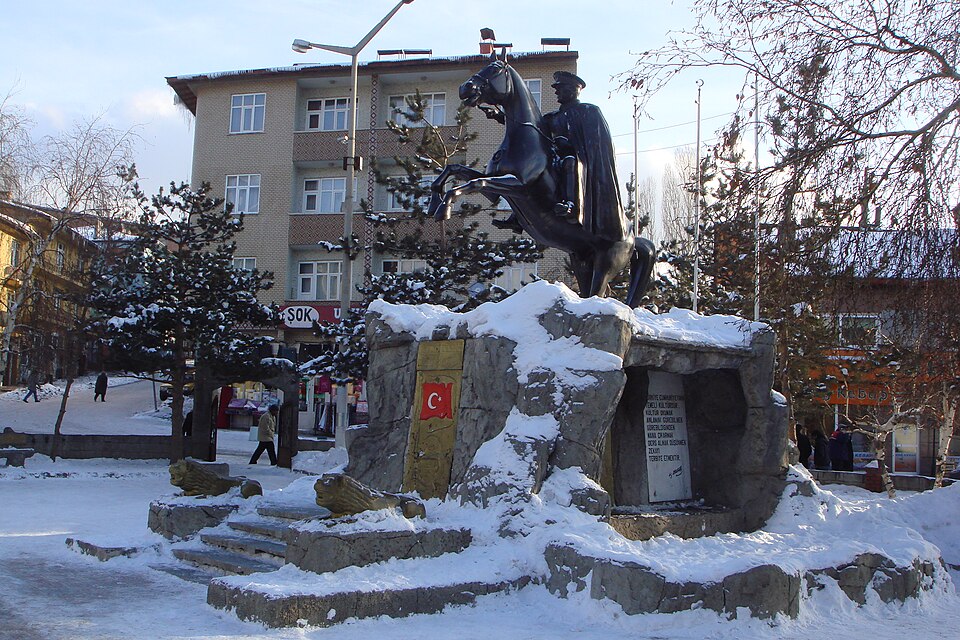
Sarıkamış today is a quiet town of some 15,000 people perched high on a plateau in Turkey's Eastern Anatolia region, a place better known now for crystalline snow and ski slopes than for its violent past. But for most of its history it was a modest, divided settlement — upper and lower Sarıkamış — of little consequence, its name tied more to obsidian trade routes stretching back to the 6th millennium BC than to military glory.
The region's deeper past is layered and contested. Obsidian quarried near Sarıkamış and from nearby Meydan Dağ turns up at Neolithic sites across the South Caucasus, including Aratashen and Khramis Didi-gora. Urartian fortresses stand on hills near the town, and in 1878 the archaeologist Alexander Yeritsian found a cuneiform inscription from the reign of the Urartian king Argishti I nearby. Medieval Armenian monasteries once filled the forests of Soğanlı to the south and east, though most had crumbled to ruin by the late 19th century.
Control of the area passed through many hands. The Seljuk sultan Alp Arslan swept through in 1064, only a few years before his decisive victory at Manzikert. Ottoman forces took the area under Selim I in 1514, and it became a liva of Kars sancak. Through the 19th century, Sarıkamış sat on the fault line between the Ottoman and Russian empires, with battles fought nearby at Zivin in 1829, 1855, and 1877. After the Russo-Turkish War of 1877–1878, the town fell under Russian rule, becoming part of Kars Oblast — a garrison town with barracks, a railway station, and a growing modern quarter in its lower half.
It was this strategic position that made Sarıkamış the stage for one of the most catastrophic battles of the First World War. In December 1914, Enver Pasha, leader of the Ittihat ve Terakki party, personally led Ottoman forces alongside his brother-in-law Hafiz Hakki Pasha in an ambitious offensive: scale Mount Allahu Ekber, converge on Sarıkamış, and drive out the Russians to cut off supply to Kars, lost to Russia decades earlier.
The plan was audacious and fragile. German military advisor Liman von Sanders warned against it, but Enver pressed on, ordering his divisions along multiple mountain routes with the hope they would arrive together. They did not. Russian Governor General Vorontsov wanted to retreat to Kars, but General Yudenich, commanding the defense, chose to stand and fight at Sarıkamış instead.
More from History

The Morning Bingham Climbed to Machu Picchu
On a cold July morning in 1911, an American historian scrambled up a jungle-choked ridge above the Urubamba River — and by afternoon, a forgotten Inca citadel would belong to the world.

The Last Half-Hour of the Hindenburg
It was already half a day late, and the public had been told to keep away — but at seven o'clock that evening, the Hindenburg finally turned toward its mooring mast for the last time.

The Last Hours of Pompeii: August 24, 79 AD
By noon it was just another hot day beside the Bay of Naples. By evening, an entire mountain had rewritten the fate of thousands.

The Longest Walk: Mandela's Last Steps to Freedom
After 27 years behind bars, a 71-year-old man had to relearn how to walk out of a prison gate — into a waiting world of cameras, crowds, and a country holding its breath.

The Document Lincoln Signed on the First Day of 1863
On a single January morning, a president's pen would change the legal status of more than three million people — if the ink held and his hand did not shake.

The Day of the Dream: August 28, 1963
Two hundred and fifty thousand people converged on the National Mall that morning — by nightfall, one voice from the steps of the Lincoln Memorial would echo for generations.