Tannenberg: The Marsh That Swallowed an Army
In the swamps east of Allenstein, a Russian general rode into the forest alone and never came back — and with him vanished an entire army.
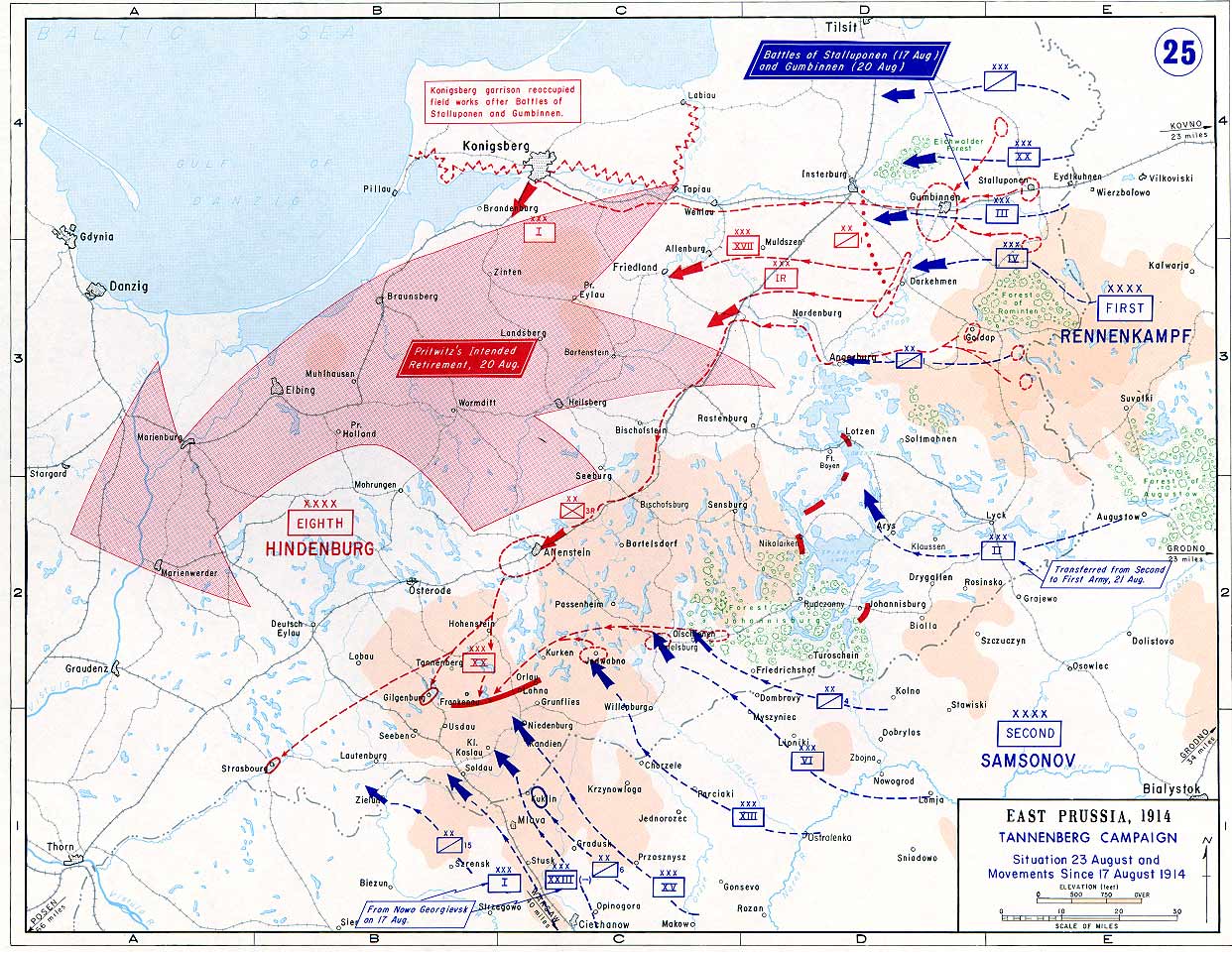
In August 1914, as the guns of the Great War had barely begun to roar, Germany faced a nightmare it had long rehearsed against on paper: two Russian armies pouring into East Prussia while the bulk of the German military was locked in the west, chasing the Schlieffen Plan's dream of a quick knockout of France. Barely ten percent of Germany's mobilized battalions stood in the east to meet them. Russia, for its part, had rushed forward faster than its own logistics could bear, driven by a promise to France that it would engage the Central Powers early, no matter the cost in preparation.
General Yakov Zhilinsky commanded the Russian Northwestern Front, overseeing both the 1st Army under Rennenkampf and the 2nd Army under Alexander Samsonov. The plan called for a coordinated advance into East Prussia, but coordination was the one thing the Russians could not manage. Communications between front and headquarters broke down repeatedly; orders contradicted earlier orders; Zhilinsky and Samsonov disagreed openly about which direction the 2nd Army should even move. Samsonov wanted to push northwest toward Allenstein and Osterode; Zhilinsky wanted a push north toward Seeburg. In the end Zhilinsky gave in, on the condition that Samsonov peel off his VI Corps toward Bischofsburg — a compromise that satisfied no one and weakened everyone.
On 22 August, Samsonov's 2nd Army pushed the Germans back in several places, and the following day struck the German XX Corps, which withdrew to the Orlau-Frankenau line. On 24 August the Russians attacked that line but were stopped by well-entrenched German defenders. Believing he had found a weakness in the German flanks, Samsonov shifted the bulk of his army northwest, convinced the Germans were on the verge of total collapse. In his confidence, he abandoned encrypted radio traffic altogether, broadcasting his army's marching orders in the clear. German commanders Paul von Hindenburg and Erich Ludendorff, though initially wary of trusting such an obvious gift, were eventually persuaded — and moved to strike.
The German counterattack was meant to begin at once, with the Russian I Corps expected to be hit on its left flank while the German XVII Corps attacked from the south. But General Hermann von François, in the field, chose to wait for his artillery before advancing, delaying the assault until 27 August. On 26 August the Russian 1st Army advanced toward Königsberg largely unopposed, while von François's own troops still held back, gathering their strength for the blow to come.
When von François finally struck on 27 August, it worked. His forces attacked at Seeburg and Bischofstein, tearing open the right flank of Samsonov's 2nd Army. That same day the Germans hit the Russian left as well, forcing the Russian I Corps to retreat that same night. By 28 August the trap had closed. Both Russian flanks — I Corps on the left, VI Corps on the right — were pulling back while the center of Samsonov's army buckled under crushing logistical strain.
More from History

The Morning Bingham Climbed to Machu Picchu
On a cold July morning in 1911, an American historian scrambled up a jungle-choked ridge above the Urubamba River — and by afternoon, a forgotten Inca citadel would belong to the world.

The Last Half-Hour of the Hindenburg
It was already half a day late, and the public had been told to keep away — but at seven o'clock that evening, the Hindenburg finally turned toward its mooring mast for the last time.

The Last Hours of Pompeii: August 24, 79 AD
By noon it was just another hot day beside the Bay of Naples. By evening, an entire mountain had rewritten the fate of thousands.

The Longest Walk: Mandela's Last Steps to Freedom
After 27 years behind bars, a 71-year-old man had to relearn how to walk out of a prison gate — into a waiting world of cameras, crowds, and a country holding its breath.

The Document Lincoln Signed on the First Day of 1863
On a single January morning, a president's pen would change the legal status of more than three million people — if the ink held and his hand did not shake.

The Day of the Dream: August 28, 1963
Two hundred and fifty thousand people converged on the National Mall that morning — by nightfall, one voice from the steps of the Lincoln Memorial would echo for generations.