The City That Bore Stalin's Name
In the rubble of a city named after the Soviet leader himself, two armies fought room by room, floor by floor, until one of Hitler's field armies did something no German army had ever done before: surrender.
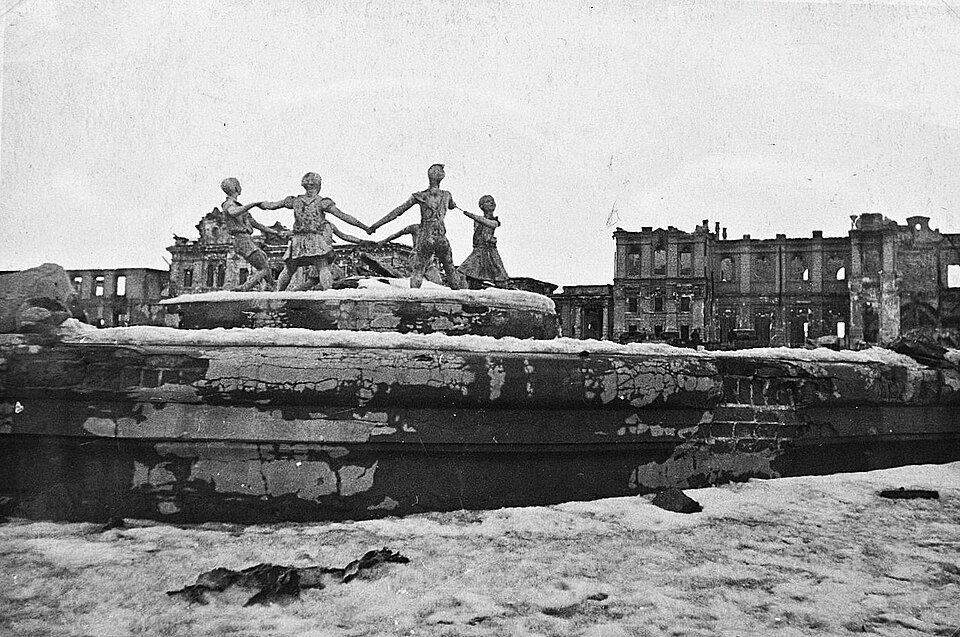
By the summer of 1942, Adolf Hitler's war machine had already swallowed Ukraine, Belarus, and the Baltic republics, yet the dream of Operation Barbarossa—crushing the Soviet Union in a single campaign—had failed. Moscow held. Leningrad was besieged but unbroken. So Hitler turned his gaze south, toward the oil fields of the Caucasus and a city on the Volga River that carried an irresistible symbolic weight: Stalingrad, named for his great rival, Joseph Stalin.
The city was no mere prize of ego. Stalingrad was one of the Soviet Union's largest industrial centers and a critical transport hub on the Volga, the artery connecting the Caucasus and Caspian oil fields to the Russian heartland. Capturing it would sever Soviet supply lines, secure the flank of the German drive toward Baku's petroleum, and choke off Lend-Lease shipments moving north through the Persian Corridor. On 23 July 1942, Hitler expanded his ambitions further, ordering not just conquest but annihilation—the city's male population to be killed, women and children deported.
The first clashes came on 17 July, as German forces met the Red Army's Stalingrad Front on the city's distant approaches. On 23 August, the German 6th Army and elements of the 4th Panzer Army launched their full offensive, backed by Luftwaffe bombing raids so intense they reduced much of Stalingrad to rubble before a single soldier crossed into its streets.
What followed was not the blitzkrieg that had carried German armies across Europe. It became something far grimmer: house-to-house, room-to-room fighting, a slow and merciless grinding match. Factories with names that would become legend—the Red October steel works, the Tractor Factory, the Barrikady gun factory—turned into fortresses. The Mamayev Kurgan hill changed hands again and again. By mid-November, after enormous cost, German forces had pushed Soviet defenders into narrow strips along the Volga's west bank, controlling perhaps ninety percent of the city. But the Volga itself was beginning to freeze, and winter arrived with brutal, punishing cold, dropping temperatures tens of degrees below freezing and bogging the fighting down into trench warfare.
Then, on 19 November 1942, the Red Army sprang a trap. Operation Uranus struck not at the German 6th Army's exhausted center but at its flanks, held by weaker Romanian and Italian armies. Those flanks collapsed almost immediately. Within days the Soviet pincers closed, and the entire German 6th Army—along with elements of the 4th Panzer Army—found itself encircled in the ruins it had spent months conquering.
More from History

The Morning Bingham Climbed to Machu Picchu
On a cold July morning in 1911, an American historian scrambled up a jungle-choked ridge above the Urubamba River — and by afternoon, a forgotten Inca citadel would belong to the world.

The Last Half-Hour of the Hindenburg
It was already half a day late, and the public had been told to keep away — but at seven o'clock that evening, the Hindenburg finally turned toward its mooring mast for the last time.

The Last Hours of Pompeii: August 24, 79 AD
By noon it was just another hot day beside the Bay of Naples. By evening, an entire mountain had rewritten the fate of thousands.

The Longest Walk: Mandela's Last Steps to Freedom
After 27 years behind bars, a 71-year-old man had to relearn how to walk out of a prison gate — into a waiting world of cameras, crowds, and a country holding its breath.

The Document Lincoln Signed on the First Day of 1863
On a single January morning, a president's pen would change the legal status of more than three million people — if the ink held and his hand did not shake.

The Day of the Dream: August 28, 1963
Two hundred and fifty thousand people converged on the National Mall that morning — by nightfall, one voice from the steps of the Lincoln Memorial would echo for generations.