The Clock at Dolmabahçe
At 09:05 on a November morning, a nation's clocks would one day stop in tribute — but inside Dolmabahçe Palace, the final hour had already arrived.
By the autumn of 1938, Mustafa Kemal Atatürk had moved into a room specially arranged for him at Dolmabahçe Palace, the official residence on the shores of the Bosphorus where he had once hosted a king. His body, weakened by cirrhosis of the liver diagnosed months earlier, had carried him through a punishing year of travel — Yalova, Ankara, Mersin, Adana — before doctors urged him back to Istanbul for treatment. The palace that had witnessed the twilight of an empire now became the setting for the final hours of the man who had built a republic on its ruins.
Through the summer he had tried to hold onto his old rhythms: chairing Council of Ministers meetings, working on the unresolved Hatay issue, receiving King Carol II of Romania aboard his newly arrived yacht, Savarona, where he stayed until the end of July. But by then his strength had ebbed too far, and he was settled into the room prepared for him within Dolmabahçe's grand halls, the same rooms once reserved for sultans.
The morning of 10 November 1938 arrived quietly within those walls. There, in the state residence he had called home during his illness, Atatürk's condition reached its end. At 09:05 local time, his long struggle with illness concluded — a moment later certified by nine medical professors who signed his death certificate, fixing the hour with clinical precision.
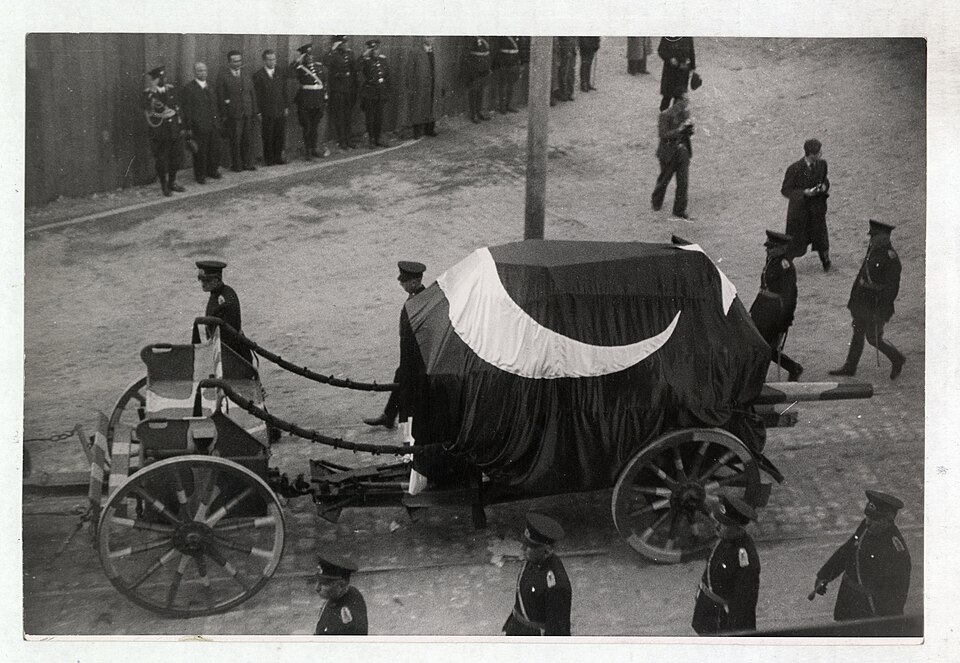
Outside the palace, the news had not yet rippled into public consciousness with full weight, but within its corridors, the machinery of a state funeral began turning almost immediately. Preparations for honoring the first president of the Republic of Turkey started under the direction of leading officials, even though no decision had yet been made about where his final resting place would be.
The very next day, on 11 November, the Parliament convened in Ankara and elected İsmet İnönü as the new president — a swift constitutional continuity enacted within twenty-four hours of the death, underscoring how quickly the machinery of state moved even as mourning began.
More from History

The Morning Bingham Climbed to Machu Picchu
On a cold July morning in 1911, an American historian scrambled up a jungle-choked ridge above the Urubamba River — and by afternoon, a forgotten Inca citadel would belong to the world.

The Last Half-Hour of the Hindenburg
It was already half a day late, and the public had been told to keep away — but at seven o'clock that evening, the Hindenburg finally turned toward its mooring mast for the last time.

The Last Hours of Pompeii: August 24, 79 AD
By noon it was just another hot day beside the Bay of Naples. By evening, an entire mountain had rewritten the fate of thousands.

The Longest Walk: Mandela's Last Steps to Freedom
After 27 years behind bars, a 71-year-old man had to relearn how to walk out of a prison gate — into a waiting world of cameras, crowds, and a country holding its breath.

The Document Lincoln Signed on the First Day of 1863
On a single January morning, a president's pen would change the legal status of more than three million people — if the ink held and his hand did not shake.

The Day of the Dream: August 28, 1963
Two hundred and fifty thousand people converged on the National Mall that morning — by nightfall, one voice from the steps of the Lincoln Memorial would echo for generations.