The Day That Changed the World
On a crisp September morning in 2001, a series of coordinated attacks shattered the skyline of New York City. The Twin Towers, symbols of American strength and ambition, fell in a matter of hours, sending shockwaves across the globe.
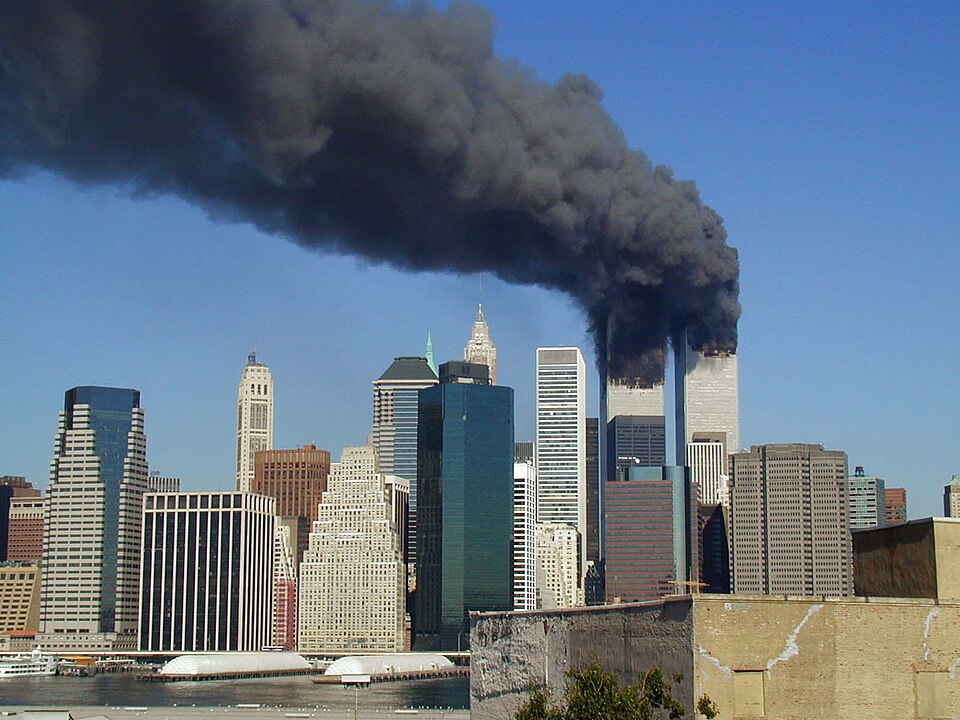
The attacks began at 8:46 a.m., when Mohamed Atta, the ringleader of the al-Qaeda plot, flew American Airlines Flight 11 into the North Tower of the World Trade Center. The impact sent a plume of smoke and debris into the sky above Lower Manhattan, marking the start of a tragic sequence of events that would change the world.
At 9:03 a.m., Marwan al-Shehhi flew United Airlines Flight 175 into the South Tower. The Twin Towers, two 110-story office buildings that had stood as symbols of American economic power, were now fatally damaged. Within an hour and forty-two minutes, both towers collapsed, destroying the remaining structures of the World Trade Center complex and devastating the surrounding area.
At 9:37 a.m., Hani Hanjour flew American Airlines Flight 77 into the Pentagon, the headquarters of the U.S. Department of Defense in Arlington County, Virginia. The impact caused a partial collapse of the building's west side, killing all 64 people aboard the plane and 125 people inside the building. Meanwhile, United Airlines Flight 93, hijacked by Ziad Jarrah, was believed to be heading for either the United States Capitol or the White House. Alerted to the earlier attacks, the passengers revolted, and the plane crashed into a field near Shanksville, Pennsylvania, at 10:03 a.m. All 44 people on board were killed, but the hijackers' plan was thwarted.
The Federal Aviation Administration ordered a ground stop for all traffic in U.S. airspace, requiring airborne aircraft to return to their point of origin or divert to Canada, where a coordinated effort known as Operation Yellow Ribbon was launched to support incoming aircraft and their passengers. The response was swift, but the damage had been done. The attacks killed 2,977 people, injured thousands more, and caused at least 10 billion dollars in infrastructure and property damage. They remain the deadliest terrorist attack in history.
That evening, the Central Intelligence Agency informed President George W. Bush that the attacks had been identified as the work of al-Qaeda under Osama bin Laden. The United States responded by launching the war on terror and invading Afghanistan, a foreign policy agenda that would be conducted over the next two decades. NATO invoked Article 5 of the North Atlantic Treaty, the only time in the alliance's history it has done so.
More from History

The Morning Bingham Climbed to Machu Picchu
On a cold July morning in 1911, an American historian scrambled up a jungle-choked ridge above the Urubamba River — and by afternoon, a forgotten Inca citadel would belong to the world.

The Last Half-Hour of the Hindenburg
It was already half a day late, and the public had been told to keep away — but at seven o'clock that evening, the Hindenburg finally turned toward its mooring mast for the last time.

The Last Hours of Pompeii: August 24, 79 AD
By noon it was just another hot day beside the Bay of Naples. By evening, an entire mountain had rewritten the fate of thousands.

The Longest Walk: Mandela's Last Steps to Freedom
After 27 years behind bars, a 71-year-old man had to relearn how to walk out of a prison gate — into a waiting world of cameras, crowds, and a country holding its breath.

The Document Lincoln Signed on the First Day of 1863
On a single January morning, a president's pen would change the legal status of more than three million people — if the ink held and his hand did not shake.

The Day of the Dream: August 28, 1963
Two hundred and fifty thousand people converged on the National Mall that morning — by nightfall, one voice from the steps of the Lincoln Memorial would echo for generations.