The Empire That Vanished Into the Steppe
They ruled a crossroads of empires from the Volga to the Caucasus between the 7th and 10th centuries, converted their elite to a faith no neighboring power shared, and then all but disappeared from history. Who were the Khazars?
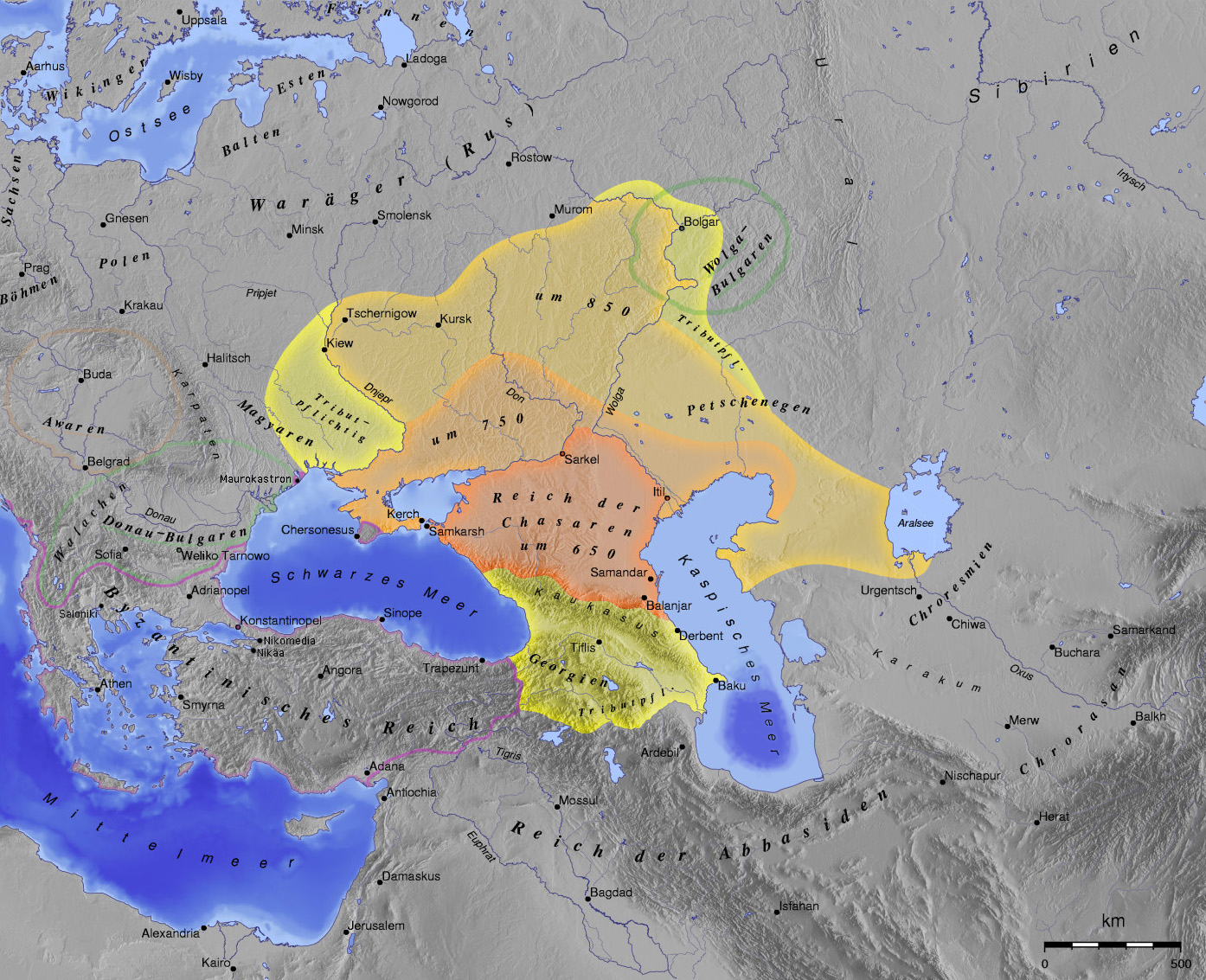
In the late 6th century, out of the wreckage of the Western Turkic Khaganate, a semi-nomadic Turkic people called the Khazars rose to command one of the great commercial empires of the early medieval world. Their territory stretched across what is now southern European Russia, southern Ukraine, and western Kazakhstan, straddling a vital artery of trade between Eastern Europe and West Asia. For roughly three centuries, from around 650 to 965, the Khazars dominated the steppes between the Volga and Don rivers, eastern Crimea, and the northern Caucasus — a position that made them indispensable middlemen between China, West Asia, and the emerging Kievan Rus'.
Their formal appearance in recorded history dates to 626-627, when the Byzantine Emperor Herakleios requested 40,000 Khazar cavalry to help him campaign against Sasanian Persia. A later meeting between Byzantine representatives and Khazar leaders beneath the walls of Tbilisi is often treated as the true starting point of Khazar history proper. The relationship deepened over the following century: in 733, Byzantine Emperor Leo III married his son, the future Constantine V, to Tzitzak, daughter of the Khazar Khagan — a marriage alliance binding empire and khaganate together. The 10th-century Islamic historian al-Mas'udi later argued that this long historical arc showed the Khazars to be the continuation of the Sabir Turks.
Who exactly the Khazars were remains genuinely uncertain. No indigenous Khazar-language records survive, and their state was deliberately, thoroughly multilingual and polyethnic — a confederation rather than a single nation. Soviet-era historians debated whether they were native to the North Caucasus; others, including D.M. Dunlop and Peter Golden, traced possible links to the Tiele or Uyghur peoples, though Golden argued the stronger connection ran through the Oghuric-speaking tribes rather than the Uyghurs directly. Chinese sources referred to them as 'Turk-Khazars,' and Byzantine records from 586 already knew them distinctly as Khazars while still calling them Turks.
The Persian geographers Istakhri and Ibn Hawqal insisted that 'Khazar' was not even an ethnic name at all, but simply the name given to the country whose capital was Itil. Istakhri also divided the population into 'White Khazars' and 'Black Khazars' — the former fair-skinned, blue-eyed, red-haired nobility and royalty, the latter a darker-skinned lower class. Scholars today largely agree this was a social distinction rather than a racial one, even though several contemporary Arab writers, including Ibn Rabbihi and Ibn Sa'd al-Maghribi, independently described the Khazars as pale, blue-eyed, and red-haired. Anthropological study of the ruling elite, meanwhile, has pointed toward Inner Asian, Mongoloid-associated features — a contradiction that has never been fully resolved.
Linguistically, the picture is just as tangled. The royal house likely spoke an eastern variety of Common Turkic, while subject tribes spoke Oghuric languages related to Bulgar and Chuvash — much as Mongol persisted as the language of the Golden Horde's rulers even as Kipchak Turkic dominated among the ranks. The 10th-century Persian historian Istakhri claimed the Khazar language resembled no other tongue he knew, though he also likened it to Bulgharic. Alano-As speech was also widespread within the khanate.
More from History

The Morning Bingham Climbed to Machu Picchu
On a cold July morning in 1911, an American historian scrambled up a jungle-choked ridge above the Urubamba River — and by afternoon, a forgotten Inca citadel would belong to the world.

The Last Half-Hour of the Hindenburg
It was already half a day late, and the public had been told to keep away — but at seven o'clock that evening, the Hindenburg finally turned toward its mooring mast for the last time.

The Last Hours of Pompeii: August 24, 79 AD
By noon it was just another hot day beside the Bay of Naples. By evening, an entire mountain had rewritten the fate of thousands.

The Longest Walk: Mandela's Last Steps to Freedom
After 27 years behind bars, a 71-year-old man had to relearn how to walk out of a prison gate — into a waiting world of cameras, crowds, and a country holding its breath.

The Document Lincoln Signed on the First Day of 1863
On a single January morning, a president's pen would change the legal status of more than three million people — if the ink held and his hand did not shake.

The Day of the Dream: August 28, 1963
Two hundred and fifty thousand people converged on the National Mall that morning — by nightfall, one voice from the steps of the Lincoln Memorial would echo for generations.