The Etruscans: Italy Before Rome
Long before the Latin she-wolf and her legendary twins, another people ruled the hills of central Italy — and left behind a language no one has fully deciphered.
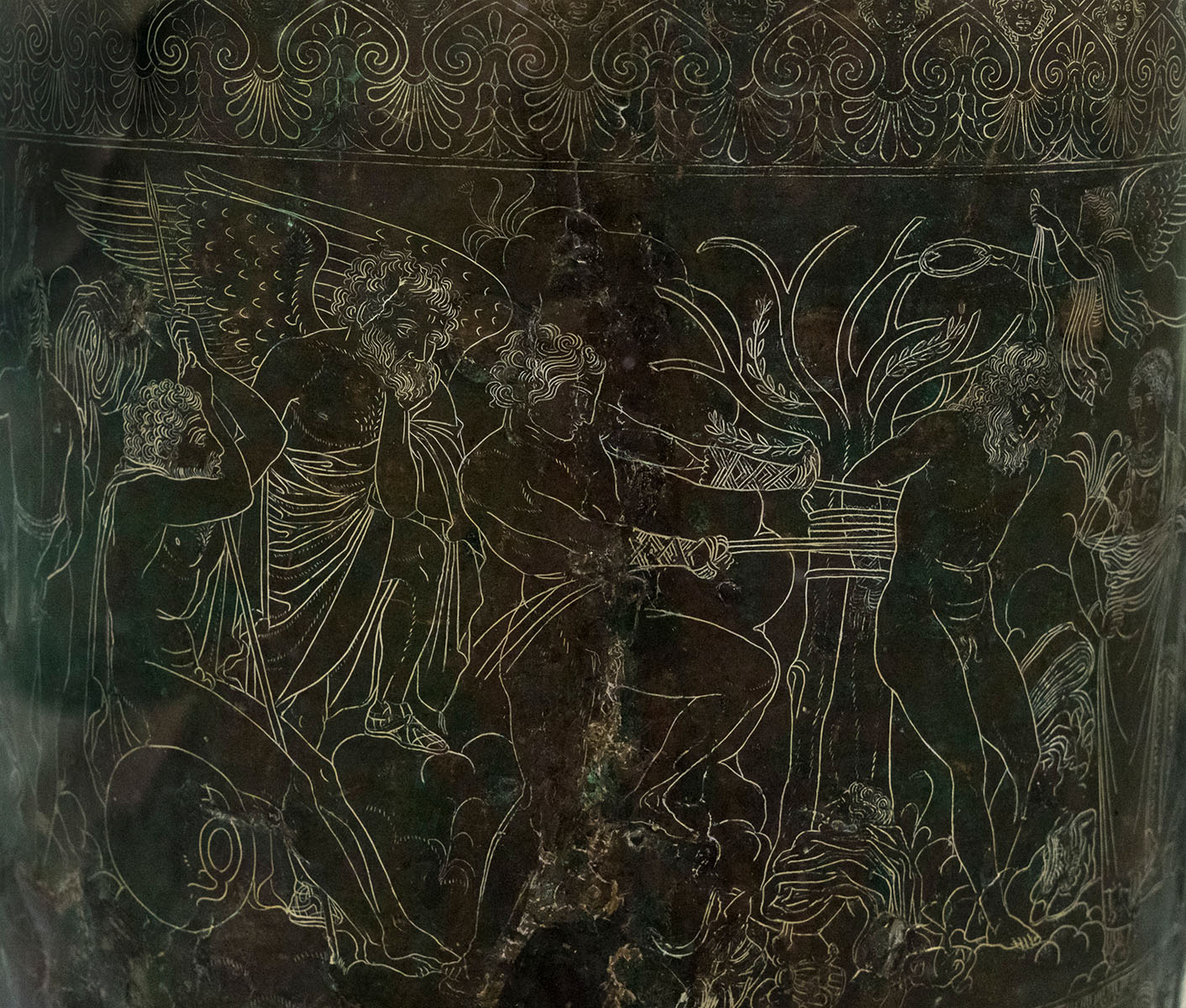
On a bronze tablet unearthed in Umbria, a single phrase survives: turskum ... nomen — 'the Tuscan name.' From that fragment, linguists have pieced together the likely path from Tursci to Etrusci, the very word Rome would use for a civilization that predated it by centuries. But the Etruscans never called themselves that. In their own inscriptions, they are Rasna — 'the people' — a word carved into boundary stones and communal markers found across ancient Etruria.
Their homeland stretched between the Tiber and Arno rivers, in what is now Tuscany, western Umbria and northern Lazio, though at its territorial height around 500 BC Etruscan influence reached into the Po Valley, Emilia-Romagna, southeastern Lombardy, southern Veneto and western Campania. The earliest identifiably Etruscan culture dates to about 900 BC, emerging from the Iron Age Villanovan culture, itself rooted in the Proto-Villanovan traditions of the late Bronze Age.
Modern scholarly consensus holds that the Etruscans were indigenous to Italy. Yet this was not always the accepted view — and it still isn't universal. The Greek historian Herodotus claimed the Etruscans migrated from Lydia in Anatolia, a theory many historians once dismissed as impossible for a sea crossing of that era. Then in 2004, geneticist Alberto Piazza of the University of Turin analyzed DNA from 80 Etruscan skeletons dating between the 7th and 3rd centuries BC. The results reopened the debate, suggesting a migration from what is now Turkey to Italy — lending new weight to the old Anatolian theories, alongside competing theories pointing to the Aegean, the Caucasus, or even, according to some Hungarian researchers, Central Asia.
Whatever their origin, the Etruscans built a civilization of striking sophistication for its time. They organized not as a single kingdom but as a federation of city-states, with authority resting in individual cities and, likely, powerful families. Twelve such cities — including Arretium (Arezzo), Tarquinii (Tarquinia), Veii, and Velzna (Volsinii, today's Orvieto) — formed a core league, while others like Felsina (Bologna), Mantua and the Corsican colony of Alalia extended their reach further still.
Elite Etruscan families grew wealthy trading with Celts to the north and Greeks to the south, filling vast family tombs with imported luxuries. Their writing system, adapted from the Euboean Greek alphabet used in southern Italy's Magna Graecia, appears in inscriptions dating to around 700 BC — among the earliest known in the region. Yet remarkably little of that written legacy survives: mostly brief graffiti, funerary inscriptions naming parents and children, and fragments quoted by later, often disapproving, Greek and Roman writers. The longest surviving Etruscan manuscript wasn't even found in Italy — it turned up wrapped around an Egyptian mummy discovered in 19th-century Alexandria.
More from History

The Morning Bingham Climbed to Machu Picchu
On a cold July morning in 1911, an American historian scrambled up a jungle-choked ridge above the Urubamba River — and by afternoon, a forgotten Inca citadel would belong to the world.

The Last Half-Hour of the Hindenburg
It was already half a day late, and the public had been told to keep away — but at seven o'clock that evening, the Hindenburg finally turned toward its mooring mast for the last time.

The Last Hours of Pompeii: August 24, 79 AD
By noon it was just another hot day beside the Bay of Naples. By evening, an entire mountain had rewritten the fate of thousands.

The Longest Walk: Mandela's Last Steps to Freedom
After 27 years behind bars, a 71-year-old man had to relearn how to walk out of a prison gate — into a waiting world of cameras, crowds, and a country holding its breath.

The Document Lincoln Signed on the First Day of 1863
On a single January morning, a president's pen would change the legal status of more than three million people — if the ink held and his hand did not shake.

The Day of the Dream: August 28, 1963
Two hundred and fifty thousand people converged on the National Mall that morning — by nightfall, one voice from the steps of the Lincoln Memorial would echo for generations.