The Hammer at the Crossroads: Tours, 732
On a Saturday in October, two armies met somewhere between two French rivers — and one man's stand would earn him the name 'Hammer.'
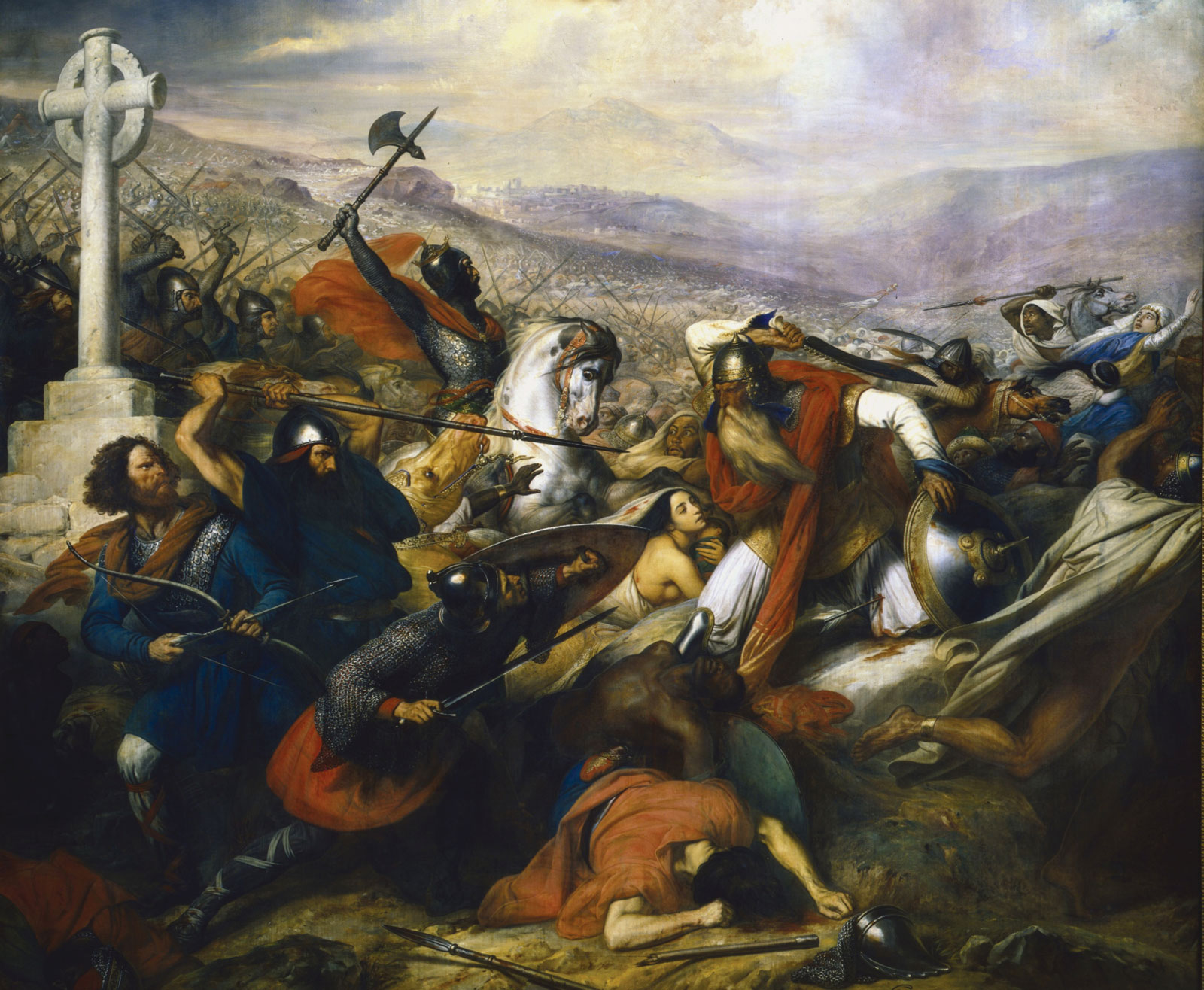
By 732, the momentum of the Umayyad Caliphate seemed unstoppable. Two decades earlier, a Muslim army under Tariq ibn Ziyad had crossed the strait later named for him and shattered the weakened Visigothic Kingdom of Iberia at the Battle of Guadalete. Only in the years that followed, once the crossing was secure, did Tariq have his own ships burned, to destroy any hope his men might have of retreat. What had been a fractious Christian realm, undermined by an unpopular king and internal revolt, became the Umayyad province of al-Andalus almost overnight.
From there, Umayyad forces pushed north, crossing the Pyrenees and probing into Gaul — the old Roman lands now ruled by the Franks. Raids and larger engagements, including a significant clash at Bordeaux, carried Umayyad arms deep into Aquitaine and Burgundy. Duke Odo of Aquitaine, having already been defeated and humiliated once by the Franks under Charles Martel, found himself squeezed between two powers. According to the Chronicles of Fredegar, as passed down through Sigebert de Gembloux, Odo — seeing himself defeated and humiliated by Charles — appealed to what the text calls 'the treacherous nation of Saracens.'
By October 732, the invading force, led by Abd al-Rahman al-Ghafiqi, governor of al-Andalus, was advancing through territory near the border between Frankish lands and Aquitaine. Charles Martel gathered his army to meet them. Most historians place the battlefield somewhere between Tours and Poitiers, near where the rivers Clain and Vienne converge — though the exact site, like so much else about this battle, is lost to time.
The numbers involved remain fiercely disputed. Medieval chroniclers and later historians offered wildly divergent estimates — anywhere from 20,000 to 80,000 men on the Umayyad side, and 15,000 to 30,000 Franks, with some older accounts inflating the figures into the hundreds of thousands. Modern historians, weighing the logistical limits of what the land could feed and sustain, tend toward far more modest numbers, with scholars like Victor Davis Hanson suggesting both armies may have been roughly comparable in size.
What almost every source agrees on is this: the Franks fought largely without heavy cavalry, holding their ground against a force that, by most accounts, was larger and harder-hit in the fighting. On 10 October 732, a Saturday, the two armies clashed. Abd al-Rahman was killed in the combat. Leaderless and battered, the Umayyad army withdrew.
More from History

The Morning Bingham Climbed to Machu Picchu
On a cold July morning in 1911, an American historian scrambled up a jungle-choked ridge above the Urubamba River — and by afternoon, a forgotten Inca citadel would belong to the world.

The Last Half-Hour of the Hindenburg
It was already half a day late, and the public had been told to keep away — but at seven o'clock that evening, the Hindenburg finally turned toward its mooring mast for the last time.

The Last Hours of Pompeii: August 24, 79 AD
By noon it was just another hot day beside the Bay of Naples. By evening, an entire mountain had rewritten the fate of thousands.

The Longest Walk: Mandela's Last Steps to Freedom
After 27 years behind bars, a 71-year-old man had to relearn how to walk out of a prison gate — into a waiting world of cameras, crowds, and a country holding its breath.

The Document Lincoln Signed on the First Day of 1863
On a single January morning, a president's pen would change the legal status of more than three million people — if the ink held and his hand did not shake.

The Day of the Dream: August 28, 1963
Two hundred and fifty thousand people converged on the National Mall that morning — by nightfall, one voice from the steps of the Lincoln Memorial would echo for generations.