The Ides of March: One Day in the Theatre of Pompey
A crown offered and refused a month earlier had settled nothing. On this morning, a circle of senators would decide the question with knives.
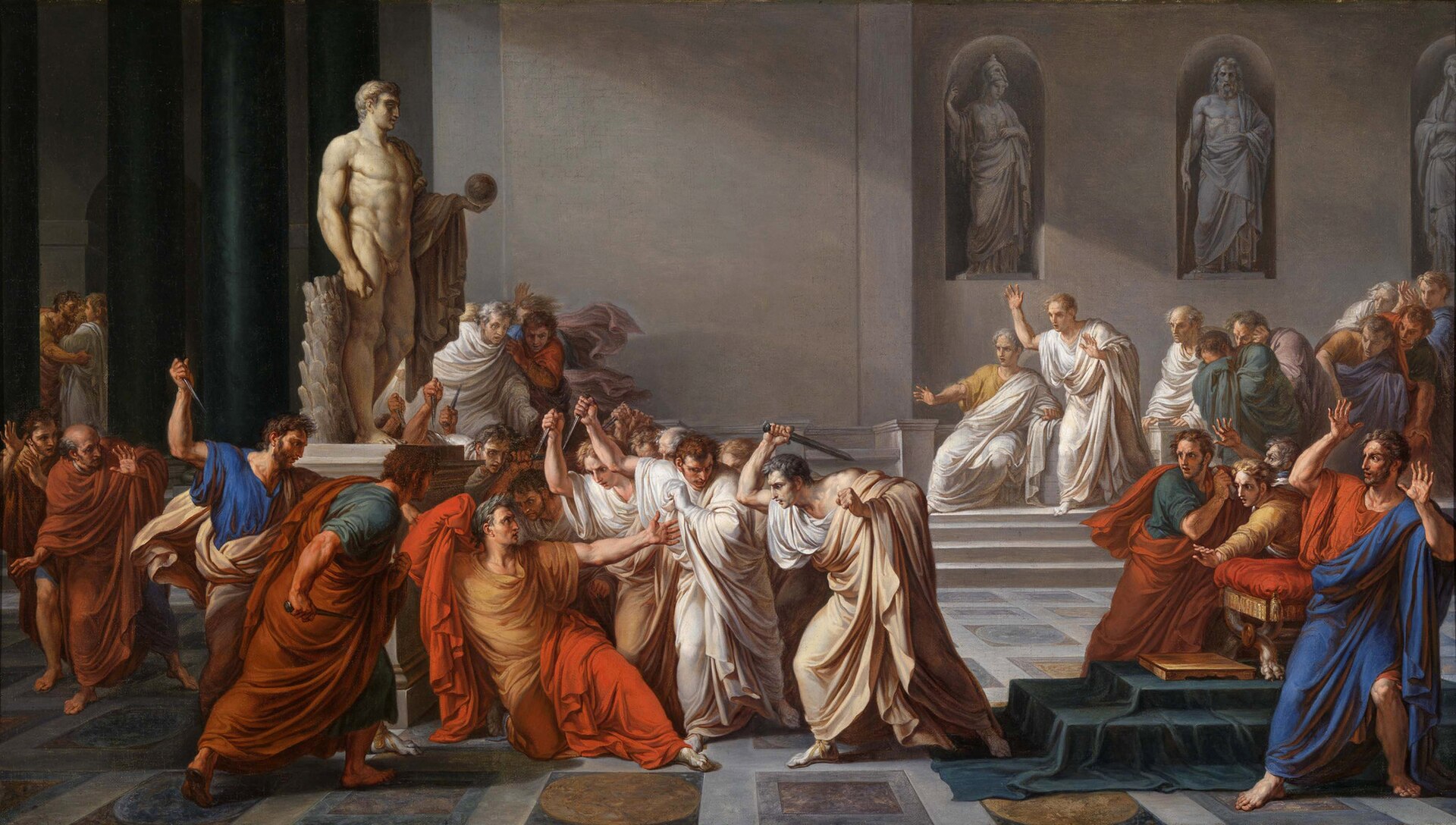
By March 15, 44 BC, Julius Caesar had been declared dictator for life by the Senate, an honor so absolute it left men wondering what Rome even meant anymore. Weeks earlier, at the festival of the Lupercal in February, Mark Antony had twice offered Caesar a royal diadem before the crowd. Caesar refused both times and had the crown carried off to the Temple of Jupiter. The gesture did not calm the unease among those who feared he intended kingship in all but name.
On this particular day, the Senate was not meeting in its usual chamber but in the Theatre of Pompey, one of the grand public spaces Caesar's old rival had built. Caesar arrived there as consul, alongside his co-consul Mark Antony, to take part in senatorial business like any other day of his rule.
Waiting among the senators was a group bound by a shared conviction that Caesar's concentration of power had to be stopped. Gaius Cassius Longinus was among them, a sharp and determined presence. Marcus Junius Brutus, whose name carried the weight of Rome's old anti-tyranny legends, stood among the conspirators as well. So did Decimus Brutus, a man Caesar trusted, who had served him as a naval commander at Massilia.// Their number and their access were exactly the point: these were not outsiders storming a fortress but colleagues Caesar walked among freely.
What unfolded in the theatre that day was the assassination itself, the group of senators moving on Caesar within the very hall meant for the business of state. The dictator who had crossed the Rubicon, who had been offered a crown and refused it, who had just weeks before been made ruler for life, was cut down by men who had sat beside him in that same Senate.
Caesar died there in the Theatre of Pompey, on the day that would forever after carry his name into infamy: the Ides of March. He was fifty-five years old, born in 100 BC, and his death came not on a battlefield but among Rome's own political class, in the very institution he was accused of hollowing out.
More from History

The Morning Bingham Climbed to Machu Picchu
On a cold July morning in 1911, an American historian scrambled up a jungle-choked ridge above the Urubamba River — and by afternoon, a forgotten Inca citadel would belong to the world.

The Last Half-Hour of the Hindenburg
It was already half a day late, and the public had been told to keep away — but at seven o'clock that evening, the Hindenburg finally turned toward its mooring mast for the last time.

The Last Hours of Pompeii: August 24, 79 AD
By noon it was just another hot day beside the Bay of Naples. By evening, an entire mountain had rewritten the fate of thousands.

The Longest Walk: Mandela's Last Steps to Freedom
After 27 years behind bars, a 71-year-old man had to relearn how to walk out of a prison gate — into a waiting world of cameras, crowds, and a country holding its breath.

The Document Lincoln Signed on the First Day of 1863
On a single January morning, a president's pen would change the legal status of more than three million people — if the ink held and his hand did not shake.

The Day of the Dream: August 28, 1963
Two hundred and fifty thousand people converged on the National Mall that morning — by nightfall, one voice from the steps of the Lincoln Memorial would echo for generations.