The Kingdom Where Gold Turned to Ash
A knot no one could untie, a king who touched gold, and a capital burned to cinders — the story of Phrygia begins in myth and ends in fact.
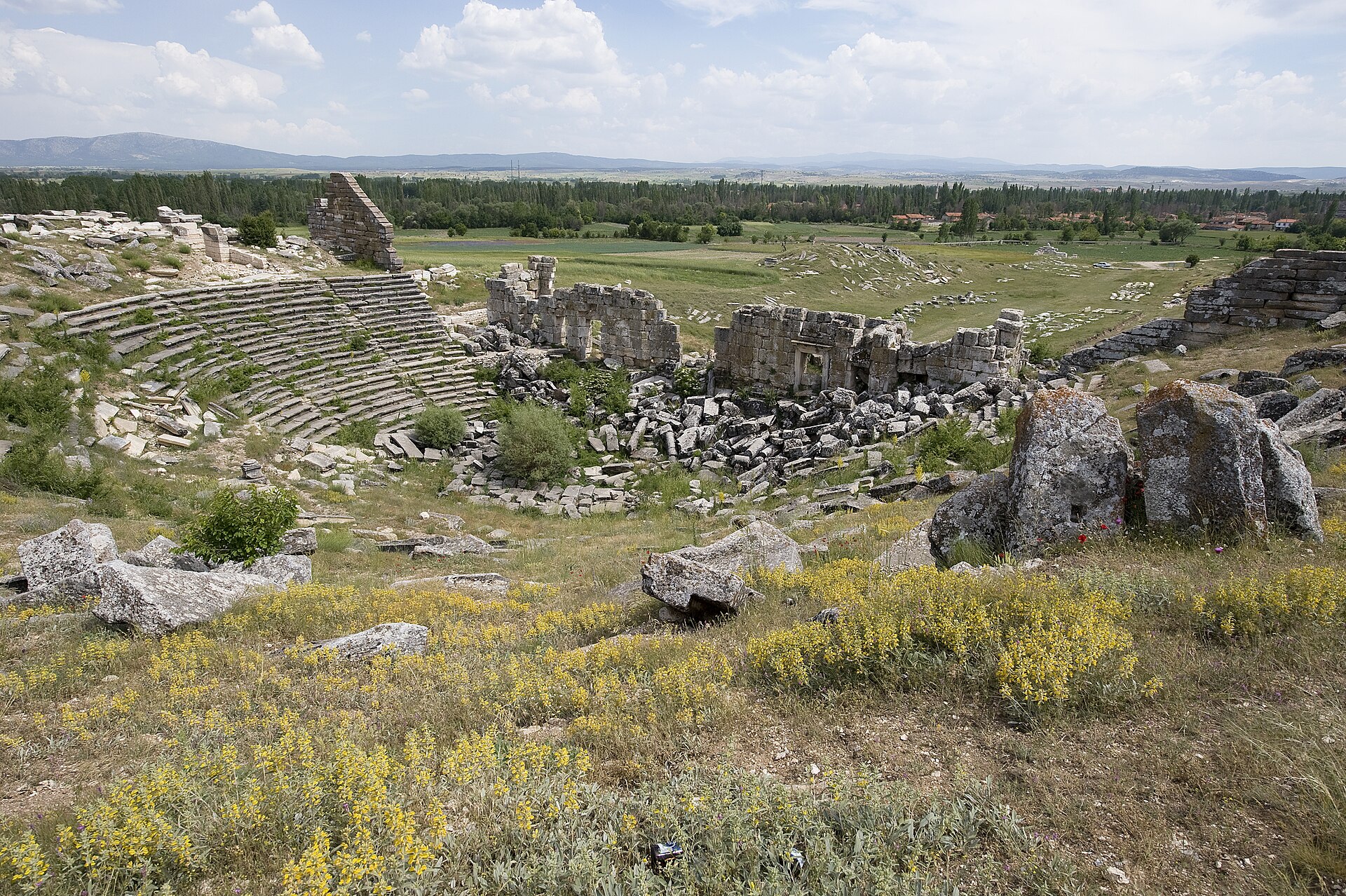
Long before Alexander the Great sliced through the Gordian Knot, before Midas's name became shorthand for a golden touch, a people called the Phrygians came down from the Balkans into the heart of Anatolia. Herodotus called them Bryges when they still lived in Europe, and traced legends of King Midas to a wild rose garden in Macedonia. Ancient historians like Strabo grouped them with the Mygdones, Mysians, Bebryces and Bithynians — a family of migrant cultures crossing from the northwest into the high, arid plateau centered on the Sangarios River.
That plateau was harsh: hot summers, cold winters, soil too dry for olives but generous enough for barley and livestock. The Phrygians settled first around Bithynia, then pushed further inland — to the Sakarya river valleys, to the upper reaches of the Gediz and Büyük Menderes, east toward the Kızılırmak and the Salt Lake. Some reached as far as Lake Burdur and the Yeşilırmak valley. Their capital, Gordium, rose near modern Eskişehir, founded, tradition says, by their first king, Gordias — the very man whose knot would outlast his kingdom by centuries.
Homer placed the Phrygians at Troy, fighting alongside the Trojans against the Achaeans. But their real historical peak came later, in the late 8th century BC, under a king named Midas — not merely a figure of fable, but a documented ruler who commanded most of western and central Anatolia and rivaled Assyria and Urartu for power. Under this Midas, Gordium flourished alongside Midas City and Pessinus. The Phrygians and Urartians even joined forces against Assyria, contesting power across a vast frontier.
Then came the Cimmerians, sweeping down from the Caucasus around 695 BC. They stormed Gordium and burned it. Legend holds that Midas, faced with this catastrophe, took his own life by drinking bull's blood. Whatever the truth of that final act, the sack of Gordium ended Phrygian independence for good. The kingdom passed to Lydia, then to Persia, then to Alexander and his Hellenistic successors, then to the Seleucids, to Pergamon, to Rome, and finally to Byzantium — a slow absorption spanning nearly a millennium.
Geographically, Phrygia was never a single fixed territory. Strabo, writing in the 1st century AD, described a Phrygia Magna — Midas's old heartland, later partly overrun by the Galatians — and a smaller Phrygia Epiktetos, an 'additionally acquired' region in the northwest around Aezanis, Nakoleia, Kotiaeum, and Dorylaeum, rescued and absorbed by the kings of Pergamon. Within this lay Phrygia Paroreia, stretching along a mountain range toward Pisidia, home to Laodicea and Apameia, the region's largest cities, along with Aphrodisias, Colossae, and others. Later, before AD 400, the Romans split the territory again into Phrygia Prima and Phrygia Secunda, later renamed Pacatiana and Salutaris.
More from History

The Morning Bingham Climbed to Machu Picchu
On a cold July morning in 1911, an American historian scrambled up a jungle-choked ridge above the Urubamba River — and by afternoon, a forgotten Inca citadel would belong to the world.

The Last Half-Hour of the Hindenburg
It was already half a day late, and the public had been told to keep away — but at seven o'clock that evening, the Hindenburg finally turned toward its mooring mast for the last time.

The Last Hours of Pompeii: August 24, 79 AD
By noon it was just another hot day beside the Bay of Naples. By evening, an entire mountain had rewritten the fate of thousands.

The Longest Walk: Mandela's Last Steps to Freedom
After 27 years behind bars, a 71-year-old man had to relearn how to walk out of a prison gate — into a waiting world of cameras, crowds, and a country holding its breath.

The Document Lincoln Signed on the First Day of 1863
On a single January morning, a president's pen would change the legal status of more than three million people — if the ink held and his hand did not shake.

The Day of the Dream: August 28, 1963
Two hundred and fifty thousand people converged on the National Mall that morning — by nightfall, one voice from the steps of the Lincoln Memorial would echo for generations.