The Kite, the Key, and the Storm
A man and his teenage son stand under a shed roof as a thunderstorm rolls in, holding a string tied to a house key. What happens next would rewrite the science of lightning.
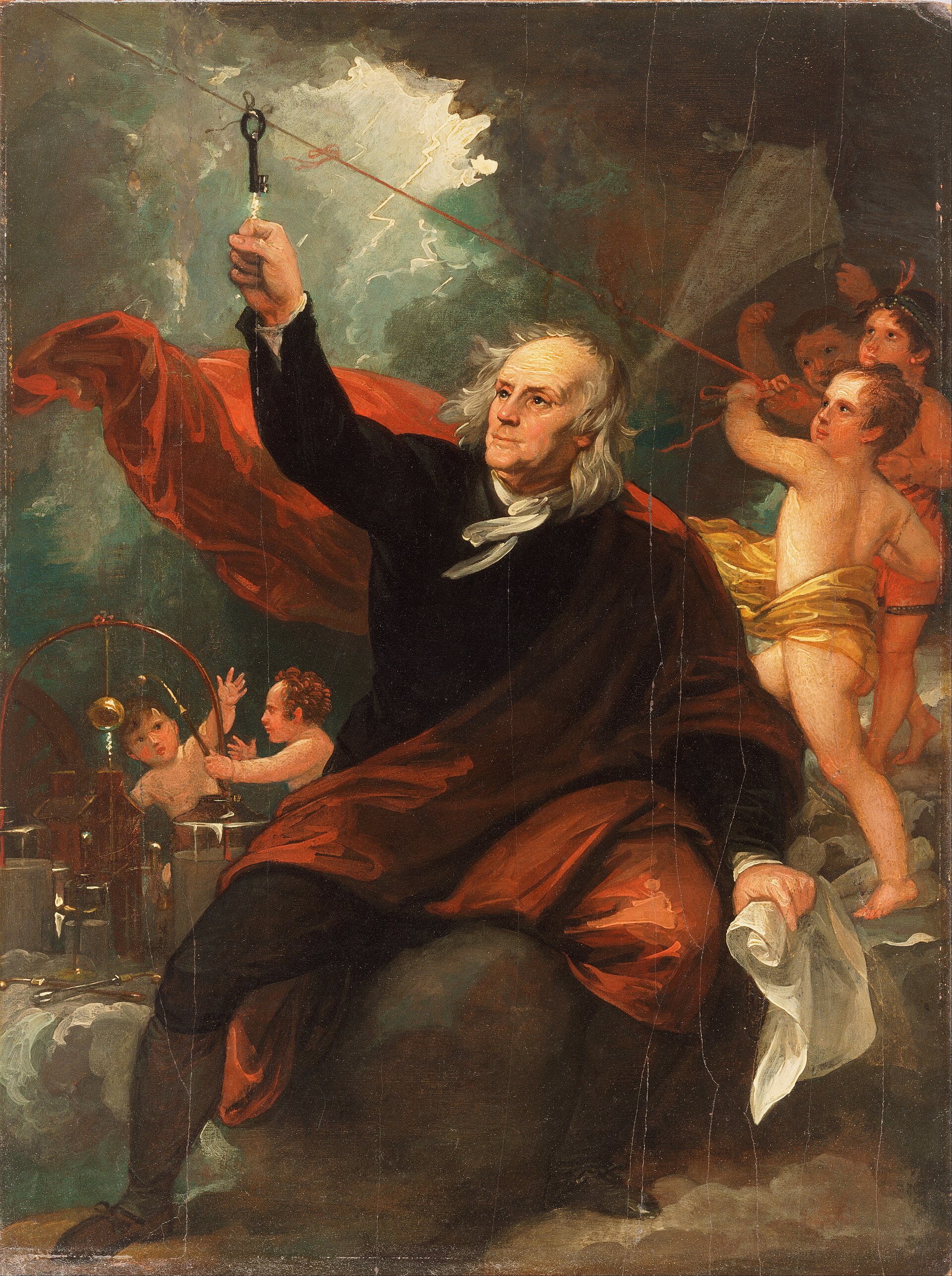
In June 1752, according to the fullest surviving account, Benjamin Franklin walked out toward a gathering thunderstorm in Philadelphia with his son William. In his hands was a kite, its apex fitted with a pointed wire, and tied to a length of hemp string. At the string's other end dangled a metal house key, borrowed from a man named Benjamin Loxley. A silk ribbon connected the key to Franklin's hand — dry silk that would not conduct electricity, meant to insulate him from whatever the storm might send down.
The question that drove Franklin into that field had been simmering in Europe for years. In 1749, Jean-Antoine Nollet's speculations had turned the electrical nature of lightning into a prize question in Bordeaux. By 1750 it was a matter of public fascination in France: Denis Barberet won acclaim there for a dissertation proposing a cause resembling what we now call the triboelectric effect, while physicist Jacques de Romas wrote his own treatise with similar ideas. That same year, Franklin abandoned his earlier doubts and began to suspect that lightning truly was attracted to high points — and that it was, in essence, electricity.
In 1752, Franklin proposed an experiment: run a conductive rod up to a great height, connect it to a Leyden jar — an early capacitor — and see if it captured a stroke of lightning. Philadelphia had no spire tall enough for the job. But in France, Thomas-François Dalibard carried out just such an experiment at Marly-la-Ville in May 1752, apparently vindicating Franklin's idea before Franklin himself had managed it. The following year, a Russian scientist named Georg Wilhelm Richmann died attempting to replicate the setup in Saint Petersburg, killed by what was believed to be ball lightning.
Franklin's own solution was more modest and, it turned out, safer: rather than a fixed rod on a spire, why not raise a conductor into the storm on a kite? He described the experiment in a letter to the Pennsylvania Gazette, published on October 19, 1752 — though notably, he never stated plainly that he himself had performed it, or when. That letter was read before the Royal Society in London on December 21, 1752, and later printed in the Philosophical Transactions.
It was left to the chemist Joseph Priestley, writing his 1767 history of electricity, to supply the fullest narrative — details he likely gathered from Franklin himself, who was living in London while Priestley wrote. Priestley described how, sheltering from the rain under an open shed to keep the silk ribbon and key dry, Franklin noticed loose threads of the kite string standing apart and repelling one another, a sign of electrical charge. He touched the key with a knuckle and drew a spark. He touched it to a Leyden jar and charged it.
More from History

The Morning Bingham Climbed to Machu Picchu
On a cold July morning in 1911, an American historian scrambled up a jungle-choked ridge above the Urubamba River — and by afternoon, a forgotten Inca citadel would belong to the world.

The Last Half-Hour of the Hindenburg
It was already half a day late, and the public had been told to keep away — but at seven o'clock that evening, the Hindenburg finally turned toward its mooring mast for the last time.

The Last Hours of Pompeii: August 24, 79 AD
By noon it was just another hot day beside the Bay of Naples. By evening, an entire mountain had rewritten the fate of thousands.

The Longest Walk: Mandela's Last Steps to Freedom
After 27 years behind bars, a 71-year-old man had to relearn how to walk out of a prison gate — into a waiting world of cameras, crowds, and a country holding its breath.

The Document Lincoln Signed on the First Day of 1863
On a single January morning, a president's pen would change the legal status of more than three million people — if the ink held and his hand did not shake.

The Day of the Dream: August 28, 1963
Two hundred and fifty thousand people converged on the National Mall that morning — by nightfall, one voice from the steps of the Lincoln Memorial would echo for generations.