The Last Sunrise Over the Theodosian Walls
By dawn on 29 May 1453, fifty-three days of siege collapsed into a single morning — and by the time the sun was fully up, an empire nearly fifteen centuries old had ceased to exist.
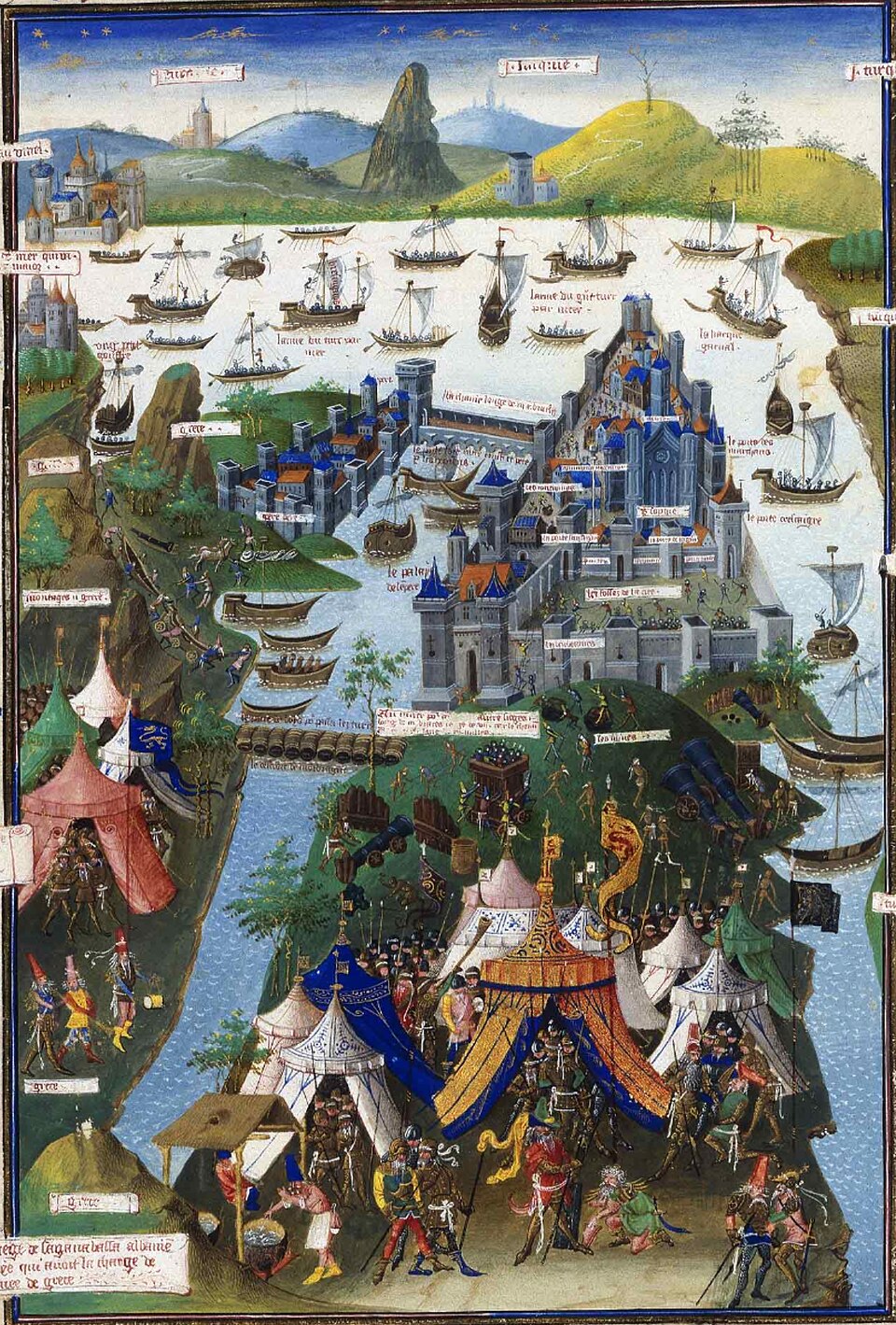
In the darkest hours before daylight on 29 May 1453, the Ottoman army under Sultan Mehmed II moved forward for the final assault on Constantinople. The siege had begun on 6 April, and for fifty-three days the Theodosian walls — among the most formidable defensive works in the world, standing for eight centuries — had held against an army that vastly outnumbered the city's defenders under Emperor Constantine XI Palaiologos.
The walls, however, were no longer whole. Mehmed's cannons and bombards had spent weeks hurling cannonballs weighing 500 kilograms over a distance of 1.5 kilometres, tearing gaps into fortifications that had never before been breached by force. It was through these broken sections that the Ottoman infantry now pressed forward in the pre-dawn hours, wave after wave, testing the exhausted Byzantine and allied defenders who had held the line day and night for nearly two months.
Across the Golden Horn, the Byzantines had strung a great iron chain, forged link by link and stretched between the towers of Kastellion and Eugenios since early April, to bar Ottoman ships from the harbor. Behind that chain, the reinforced Byzantine fleet had kept watch through the siege, one more barrier in a city that had improvised every defense it could against overwhelming odds.```
As morning broke on the 29th, the pressure on the land walls proved too great. The defenders, thinned by weeks of continuous fighting and heavily outnumbered from the outset, could not hold every breach the bombardment had opened. Ottoman soldiers pressed through the gaps torn in the ancient fortifications, pouring into the city that had resisted capture by force for eleven centuries.
Constantine XI Palaiologos led the Byzantine defense in these final hours, commanding a force that had held out far longer than the odds suggested it should. The fighting that morning marked the only successful storming of Constantinople's land walls in the entire history of the city's sieges — the sole earlier capture, in 1204, had come not from breaching the Theodosian walls but during the Fourth Crusade's sack of the city.
More from History

The Morning Bingham Climbed to Machu Picchu
On a cold July morning in 1911, an American historian scrambled up a jungle-choked ridge above the Urubamba River — and by afternoon, a forgotten Inca citadel would belong to the world.

The Last Half-Hour of the Hindenburg
It was already half a day late, and the public had been told to keep away — but at seven o'clock that evening, the Hindenburg finally turned toward its mooring mast for the last time.

The Last Hours of Pompeii: August 24, 79 AD
By noon it was just another hot day beside the Bay of Naples. By evening, an entire mountain had rewritten the fate of thousands.

The Longest Walk: Mandela's Last Steps to Freedom
After 27 years behind bars, a 71-year-old man had to relearn how to walk out of a prison gate — into a waiting world of cameras, crowds, and a country holding its breath.

The Document Lincoln Signed on the First Day of 1863
On a single January morning, a president's pen would change the legal status of more than three million people — if the ink held and his hand did not shake.

The Day of the Dream: August 28, 1963
Two hundred and fifty thousand people converged on the National Mall that morning — by nightfall, one voice from the steps of the Lincoln Memorial would echo for generations.