The Library That Refused to Die in a Single Night
Everyone knows the Library of Alexandria burned. Almost no one agrees on when, how, or if it ever really stopped smoldering for centuries.
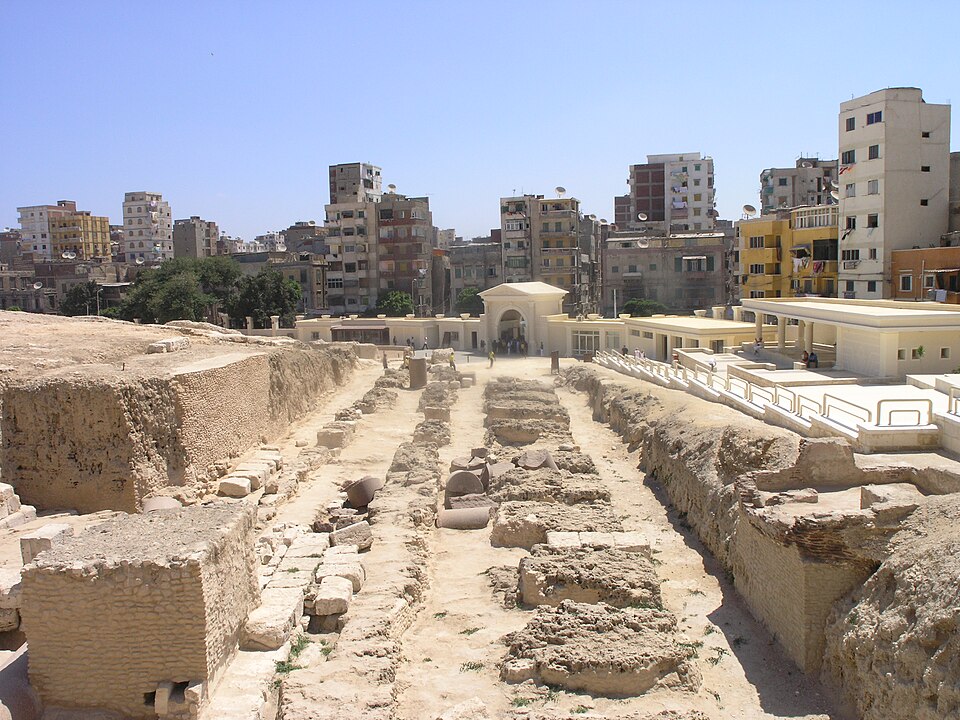
In 332 BC, Alexander the Great founded a city on the Egyptian coast that he would never live to rule. After his death, his general Ptolemy I Soter seized Egypt, crowned himself pharaoh in the old style, and married his own sister to legitimize his reign among the Egyptian people. But his most lasting act was not political — it was intellectual. Encouraged, perhaps, by the exiled Athenian statesman Demetrius of Phalerum, Ptolemy envisioned a universal library, though it was likely his son, Ptolemy II Philadelphus, who actually built it.
The library was never a standalone building but the crown jewel of the Mouseion, a research institution dedicated to the Muses. Around it grew a working scientific campus: a zoo housing specimens of animals and plants from every known land, a botanical garden, an observatory, and an anatomy theater where the human body was studied through dissection. Scholars lived and worked in dedicated houses for physics, chemistry, medicine, astronomy, mathematics, philosophy, literature, and physiology.
The Ptolemies pursued texts with the aggression of conquerors. Every ship that docked in Alexandria was searched, and any book found aboard was seized, copied, and returned only in duplicate — the original stayed in the library. Officials were dispatched abroad specifically to buy up manuscripts. Estimates of the collection's size vary wildly, from 40,000 to 700,000 scrolls by some counts, or as many as 900,000 manuscripts by others — but even the most conservative figures made it the largest library the ancient world had ever seen.
Its scholars were extraordinary. Zenodotus of Ephesus worked to standardize the text of Homer. Callimachus compiled the Pinakes, arguably history's first library catalog. Eratosthenes calculated the Earth's circumference to within a few hundred kilometers using nothing but geometry and shadows. Hero of Alexandria built the first recorded steam engine. Euclid, Archimedes, Herophilos, and Ptolemy the astronomer all passed through its halls. Under Ptolemy III, a second, daughter library was established at the Serapeum, a temple to the god Serapis.
Decline came slowly, then violently, in fits and starts. In 145 BC, Ptolemy VIII purged Alexandria's intellectuals, driving the head librarian Aristarchus of Samothrace to resign and exile himself to Cyprus, while scholars like Dionysius Thrax scattered across the Mediterranean. In 48 BC, Julius Caesar's forces accidentally set fire to part of the city during civil war, and the library — or some portion of it — burned. Yet it seems to have survived or been rebuilt: the geographer Strabo visited the Mouseion around 20 BC, and scholarly work continued there for generations after.
More from History

The Morning Bingham Climbed to Machu Picchu
On a cold July morning in 1911, an American historian scrambled up a jungle-choked ridge above the Urubamba River — and by afternoon, a forgotten Inca citadel would belong to the world.

The Last Half-Hour of the Hindenburg
It was already half a day late, and the public had been told to keep away — but at seven o'clock that evening, the Hindenburg finally turned toward its mooring mast for the last time.

The Last Hours of Pompeii: August 24, 79 AD
By noon it was just another hot day beside the Bay of Naples. By evening, an entire mountain had rewritten the fate of thousands.

The Longest Walk: Mandela's Last Steps to Freedom
After 27 years behind bars, a 71-year-old man had to relearn how to walk out of a prison gate — into a waiting world of cameras, crowds, and a country holding its breath.

The Document Lincoln Signed on the First Day of 1863
On a single January morning, a president's pen would change the legal status of more than three million people — if the ink held and his hand did not shake.

The Day of the Dream: August 28, 1963
Two hundred and fifty thousand people converged on the National Mall that morning — by nightfall, one voice from the steps of the Lincoln Memorial would echo for generations.