The Lion of Plevna: Osman Pasha's 145-Day Stand
For nearly five months, a walled town of vineyards and earthworks held off two empires — and made an ordinary Ottoman general into a legend.
On 20 July 1877, dust rose over the rocky valley south of Nikopol as Osman Nuri Pasha's exhausted columns marched into Plevna. He had set out to relieve Nikopol, only to learn on the road that the fortress had already fallen to the Russians. Rather than retreat, he turned his army toward this modest town among the vineyards, a place that commanded the key roads into the Balkan Mountains. Within days his men were digging trenches, raising redoubts, and quarrying gun emplacements out of the hillsides.
The Russians, under Grand Duke Nicholas, had crossed the Danube almost unopposed and expected little resistance. On 19 July, General Yuri Schilder-Schuldner's 5th Division began bombarding Plevna, and the next day his troops seized some outer defenses. But Osman Pasha counterattacked with reinforcements, driving the Russians out at a cost of 3,000 Russian casualties against 2,000 of his own — the first battle of Plevna was an Ottoman victory.
Osman used the respite to strengthen his lines further, and by the end of July his garrison had grown to 22,000 men with 58 guns. The Russians, reinforced by the army of Prince Carol of Romania, now commanding the joint force, attacked again on 31 July with 35,000 troops and 176 guns. General Alexey Schakhovskoy's cavalry struck the eastern redoubts while General Mikhail Skobelev assaulted Grivitsa in the north. Two redoubts fell briefly, but by nightfall Osman's men had retaken the ground, inflicting 7,300 Russian casualties against just over 2,000 of their own.
Osman failed to press his advantage after this second victory, though he did launch a cavalry sortie on 31 August that cost the Russians 1,300 men and his own side 1,000. The Russians kept pouring in reinforcements, and by September the Grand Duke's army swelled to 100,000. On 3 September, Skobelev captured Lovech, cutting one of Osman's supply lines before he could relieve it; survivors were folded into three battalions defending Plevna. Osman's strength peaked at 30,000 men, bolstered by thirteen fresh battalions.
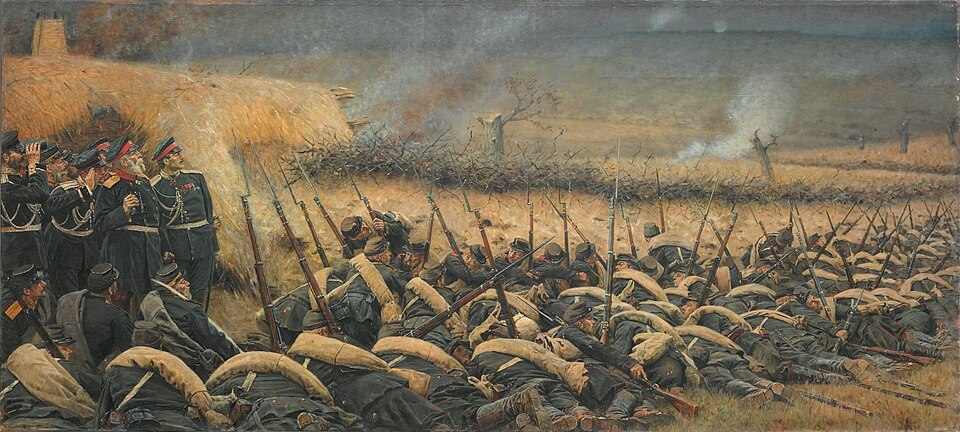
That August, Romanian troops under General Alexandru Cernat crossed the Danube, adding 43,414 men to the siege. On 11 September, Russian and Romanian forces launched their largest assault yet — the 'Great Assault.' Dug into their positions with German Krupp artillery and American Winchester and Peabody-Martini rifles, the Ottoman defenders held off wave after wave for three hours. Tsar Alexander II and Grand Duke Nicholas watched from a hillside pavilion beyond the line of fire as Skobelev captured two southern redoubts and Romanian troops took the Grivitsa redoubt — the only position the besiegers would permanently hold.
More from History

The Morning Bingham Climbed to Machu Picchu
On a cold July morning in 1911, an American historian scrambled up a jungle-choked ridge above the Urubamba River — and by afternoon, a forgotten Inca citadel would belong to the world.

The Last Half-Hour of the Hindenburg
It was already half a day late, and the public had been told to keep away — but at seven o'clock that evening, the Hindenburg finally turned toward its mooring mast for the last time.

The Last Hours of Pompeii: August 24, 79 AD
By noon it was just another hot day beside the Bay of Naples. By evening, an entire mountain had rewritten the fate of thousands.

The Longest Walk: Mandela's Last Steps to Freedom
After 27 years behind bars, a 71-year-old man had to relearn how to walk out of a prison gate — into a waiting world of cameras, crowds, and a country holding its breath.

The Document Lincoln Signed on the First Day of 1863
On a single January morning, a president's pen would change the legal status of more than three million people — if the ink held and his hand did not shake.

The Day of the Dream: August 28, 1963
Two hundred and fifty thousand people converged on the National Mall that morning — by nightfall, one voice from the steps of the Lincoln Memorial would echo for generations.