The Man Who Didn't Conduct His Own Symphony
Every retelling of the Ninth's premiere paints the same picture: a totally deaf Beethoven, alone at the podium, willing a symphony into being through sheer force of genius. The truth on stage that night in Vienna was stranger — and it involved two other men doing the actual work.
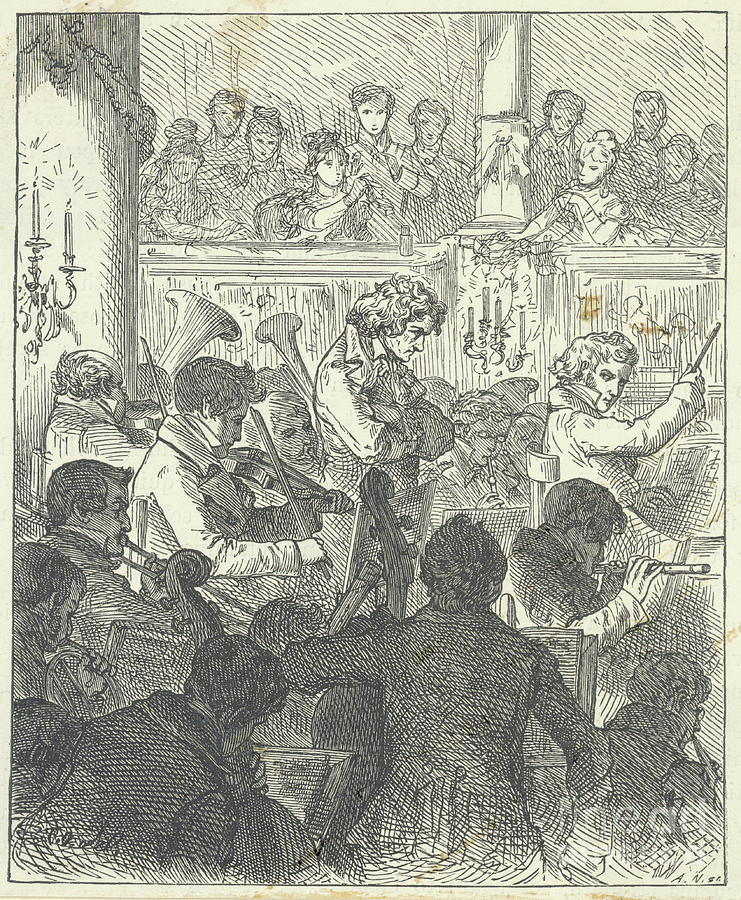
The image is irresistible: Beethoven, stone deaf, standing before an orchestra and chorus, conducting the greatest symphony ever written purely from memory and imagination. It has become one of classical music's most cherished legends, repeated in documentaries and textbooks alike. But the historical record from the night of 7 May 1824, at Vienna's Theater am Kärntnertor, tells a more complicated story.
Beethoven was indeed almost completely deaf by 1824, and he did share the stage during the premiere of Symphony No. 9. But he was not, in any functional sense, the conductor. The performance was officially led by Michael Umlauf, the theatre's Kapellmeister. Umlauf had good reason to take charge: two years earlier he had watched Beethoven attempt to conduct a rehearsal for a revision of his opera Fidelio, and it had ended in disaster. This time, Umlauf quietly instructed the singers and musicians to ignore Beethoven entirely.
So what was Beethoven actually doing up there? He sat by the stage, giving tempos at the start of each section, turning the pages of his own score, and beating time for an orchestra he could not hear play a single note. It was a gesture of authorship, not direction — a composer physically present at the birth of his own masterpiece, unable to hear a bar of it.
The most vivid firsthand account comes from violinist Joseph Böhm, who performed that night. He recalled Beethoven standing in front of a conductor's stand, throwing himself back and forth 'like a madman,' stretching to his full height one moment, crouching to the floor the next, flailing his hands and feet as if he wanted to play every instrument and sing every choral part himself. It is a startling, almost tragic image — but Böhm is explicit that this was performance, not command.
According to Böhm, the actual direction of the orchestra was in the hands of Louis Duport, and the musicians followed only his baton. Between Umlauf's official leadership and Duport's baton, Beethoven's frantic gestures at the front of the stage were essentially theatrical — moving, sincere, but disconnected from the mechanics of the performance itself.
More from History

The Morning Bingham Climbed to Machu Picchu
On a cold July morning in 1911, an American historian scrambled up a jungle-choked ridge above the Urubamba River — and by afternoon, a forgotten Inca citadel would belong to the world.

The Last Half-Hour of the Hindenburg
It was already half a day late, and the public had been told to keep away — but at seven o'clock that evening, the Hindenburg finally turned toward its mooring mast for the last time.

The Last Hours of Pompeii: August 24, 79 AD
By noon it was just another hot day beside the Bay of Naples. By evening, an entire mountain had rewritten the fate of thousands.

The Longest Walk: Mandela's Last Steps to Freedom
After 27 years behind bars, a 71-year-old man had to relearn how to walk out of a prison gate — into a waiting world of cameras, crowds, and a country holding its breath.

The Document Lincoln Signed on the First Day of 1863
On a single January morning, a president's pen would change the legal status of more than three million people — if the ink held and his hand did not shake.

The Day of the Dream: August 28, 1963
Two hundred and fifty thousand people converged on the National Mall that morning — by nightfall, one voice from the steps of the Lincoln Memorial would echo for generations.