The Night the Unsinkable Ship Went Down
At 23:40 the sea was glass-still and starlit — and that was the problem. In the two hours and forty minutes that followed, the largest ship in the world would vanish beneath the North Atlantic.
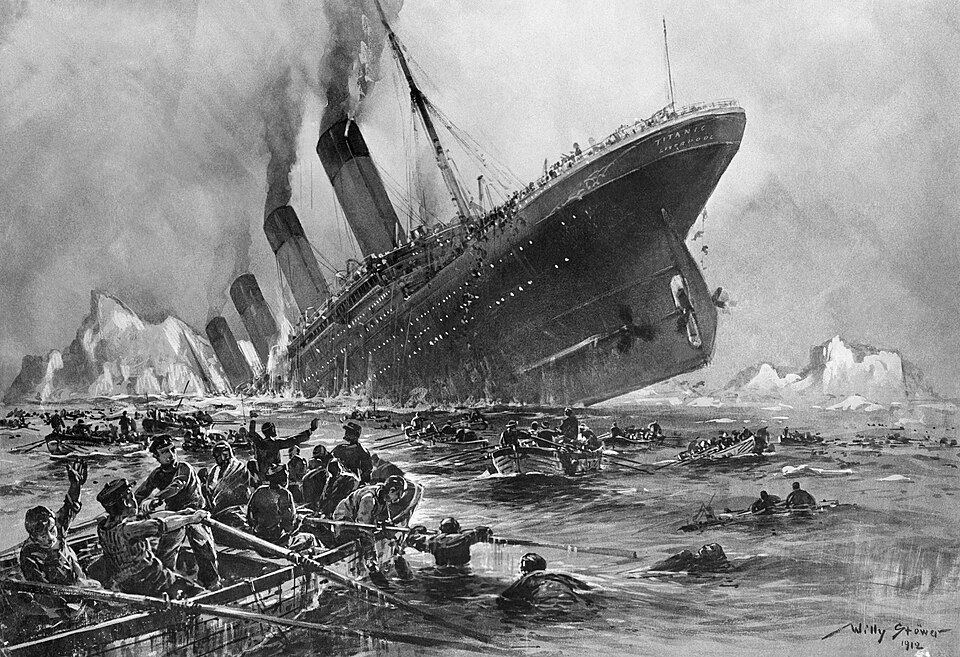
By the evening of 14 April 1912, Titanic's wireless operators had already logged six warnings of drifting ice. At 09:00 the Caronia had reported 'bergs, growlers,' and Captain Smith acknowledged it. At 13:42 the Baltic relayed word from the Greek ship Athenia of icebergs and field ice ahead; Smith passed the message to White Star Line chairman J. Bruce Ismay, who was aboard for the maiden voyage, and ordered a new, more southerly course. At 13:45 the German liner America reported passing two large icebergs — but that message never reached the bridge, lost perhaps amid repairs to faulty equipment.
As night fell, most passengers went to bed. Command of the bridge had passed from Second Officer Charles Lightoller to First Officer William Murdoch. High in the crow's nest, 29 metres above the deck, lookouts Frederick Fleet and Reginald Lee scanned a sea so calm it seemed like glass, the stars reflected without a ripple. It was near freezing, moonless, and eerily still — conditions that stripped away the one clue that might have betrayed an iceberg's position: waves breaking against its base.
Titanic was travelling at roughly 22 knots, near her top speed, when at 23:40 Fleet spotted a dark mass ahead and rang the warning bell three times, phoning the bridge: 'Iceberg, right ahead!' Murdoch ordered the engines reversed and the wheel turned hard, but the ship — over 880 feet of steel — could not answer in time. The hull suffered a glancing blow along the starboard side, buckling plates and opening six of sixteen watertight compartments to the sea, including the forward hold and boiler rooms five and six.
Titanic had been designed to survive flooding in up to four forward compartments. Six had been breached. Within minutes, officers and the ship's designer, present aboard, understood the ship was doomed. Crew began waking passengers and preparing the twenty lifeboats — sixteen wooden, four collapsible — a number never meant to hold the more than 2,200 people aboard, since lifeboats of that era were built to ferry passengers to nearby rescuers, not to save everyone at once.
Distress rockets were fired into the black sky and wireless operators sent call after call for help, but confusion, poor organisation, and passengers reluctant to leave a ship that felt safer than the lifeboats meant many boats were lowered only partly full. Two were never launched from their davits at all, floating free as the ship settled, later becoming refuges for people already in the water.
More from History

The Morning Bingham Climbed to Machu Picchu
On a cold July morning in 1911, an American historian scrambled up a jungle-choked ridge above the Urubamba River — and by afternoon, a forgotten Inca citadel would belong to the world.

The Last Half-Hour of the Hindenburg
It was already half a day late, and the public had been told to keep away — but at seven o'clock that evening, the Hindenburg finally turned toward its mooring mast for the last time.

The Last Hours of Pompeii: August 24, 79 AD
By noon it was just another hot day beside the Bay of Naples. By evening, an entire mountain had rewritten the fate of thousands.

The Longest Walk: Mandela's Last Steps to Freedom
After 27 years behind bars, a 71-year-old man had to relearn how to walk out of a prison gate — into a waiting world of cameras, crowds, and a country holding its breath.

The Document Lincoln Signed on the First Day of 1863
On a single January morning, a president's pen would change the legal status of more than three million people — if the ink held and his hand did not shake.

The Day of the Dream: August 28, 1963
Two hundred and fifty thousand people converged on the National Mall that morning — by nightfall, one voice from the steps of the Lincoln Memorial would echo for generations.