The Ships That (Maybe) Walked: What the Sources Actually Say
Every schoolchild's version of 1453 includes a jaw-dropping image: Ottoman warships hauled overland on greased logs to slip past Constantinople's harbor defenses. But when you go looking for that scene in the historical record at hand, something strange happens — it simply isn't there.
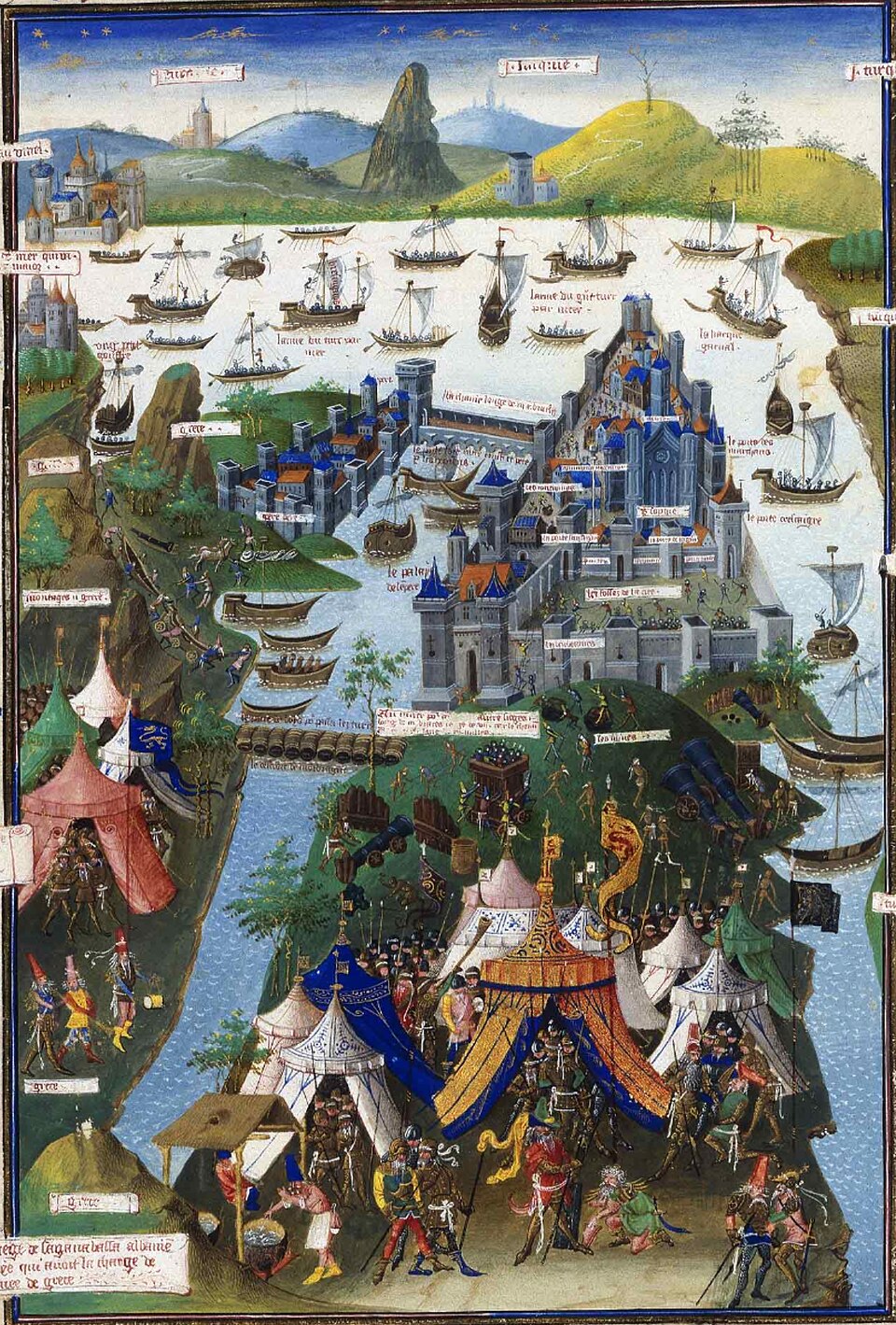
The popular belief is specific and vivid: Mehmed II, frustrated by a chain blocking the Golden Horn, ordered his fleet dragged over the hills of Galata on wooden rollers, landing them behind Byzantine lines and turning the siege. It's one of the most repeated 'facts' about the fall of Constantinople, retold in documentaries and textbooks as proof of Ottoman ingenuity. Yet the detailed accounts of the siege's preparations and events, as recorded here, never mention this maneuver at all.
What the sources do describe, in careful detail, is the chain itself — and it is a story worth telling on its own terms. The Byzantines, remembering how a Latin fleet had disabled their harbor defenses during the Fourth Crusade in 1204, had learned from that failure. They reinforced the tower at Galata where the chain anchored and encircled it with walls. For the 1453 siege, their navy was strengthened, and in February 1453 ships in the harbor were asked to stay and defend the city — though many fled instead.
On 2 April 1453, a chain built by Bartalomeo Soligo was stretched between the towers of Kastellion and Eugenios, sealing off the Golden Horn. This was not a symbolic gesture: the chain was made of wrought iron links of varying thickness, from 1.9 to 6.2 centimeters, forged to withstand exactly the kind of naval assault the Ottomans might attempt. Behind it, the Byzantine fleet kept watch, and the defenders also had access to Greek fire, a weapon that could not be extinguished by water and was usable in both naval and land combat.
The siege itself, which the sources describe in firm outline, ran from 6 April to 29 May 1453 — fifty-three days in total. Mehmed II's forces battered the city's walls with cannons of a scale never before seen, eventually breaking through what had been, for eight centuries, some of the most formidable fortifications in the world. The city fell on the morning of 29 May.
So where does the ships-on-land legend fit into this documented sequence? Based on the material available here, it doesn't — at least not explicitly. The sources trace the naval standoff at the chain, the reinforcement of towers, the flight of foreign ships from the harbor, and the eventual overland preparations Mehmed made for his siege — including new roads and bridges built by fifty carpenters and two hundred artisans to move his massive cannons from Adrianople. That infrastructure effort, real and well-attested, may be part of where the legend's imagery comes from: an army capable of moving enormous bombards over land was clearly capable of remarkable engineering feats.
More from History

The Morning Bingham Climbed to Machu Picchu
On a cold July morning in 1911, an American historian scrambled up a jungle-choked ridge above the Urubamba River — and by afternoon, a forgotten Inca citadel would belong to the world.

The Last Half-Hour of the Hindenburg
It was already half a day late, and the public had been told to keep away — but at seven o'clock that evening, the Hindenburg finally turned toward its mooring mast for the last time.

The Last Hours of Pompeii: August 24, 79 AD
By noon it was just another hot day beside the Bay of Naples. By evening, an entire mountain had rewritten the fate of thousands.

The Longest Walk: Mandela's Last Steps to Freedom
After 27 years behind bars, a 71-year-old man had to relearn how to walk out of a prison gate — into a waiting world of cameras, crowds, and a country holding its breath.

The Document Lincoln Signed on the First Day of 1863
On a single January morning, a president's pen would change the legal status of more than three million people — if the ink held and his hand did not shake.

The Day of the Dream: August 28, 1963
Two hundred and fifty thousand people converged on the National Mall that morning — by nightfall, one voice from the steps of the Lincoln Memorial would echo for generations.