The Sword That May Never Have Fallen
Everyone knows how Alexander the Great beat the unbeatable knot — he simply hacked it apart with his sword. But the ancient historians who actually wrote it down couldn't agree on what happened.
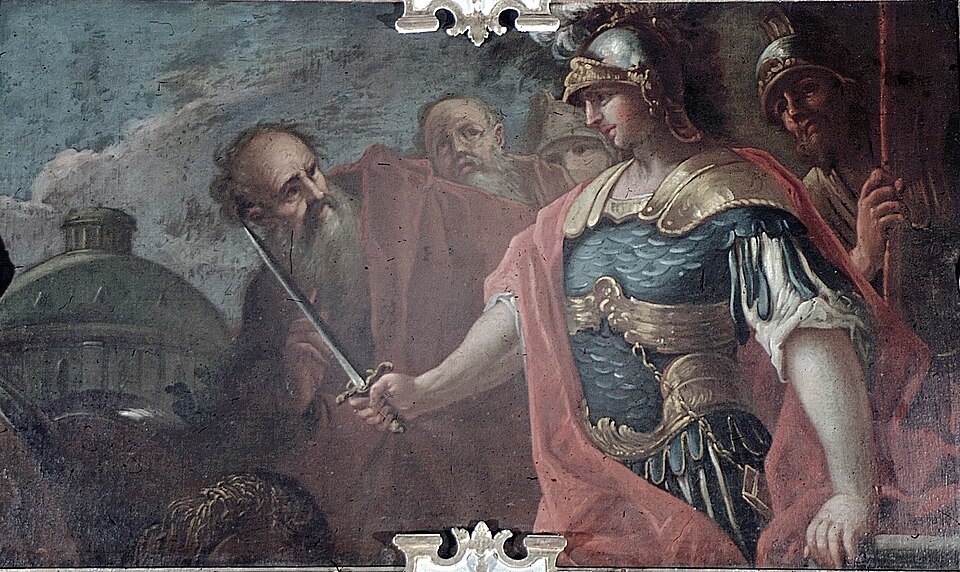
The story arrives pre-packaged as a lesson in decisive action: a knot no one could untie, a prophecy that whoever loosed it would rule Asia, and a young conqueror who solved the puzzle by refusing to play by its rules, slicing it open with one stroke of his blade. It has become shorthand for cutting through complexity rather than untangling it. The trouble is that this tidy image, repeated for over two thousand years, is not what the earliest sources agree happened.
The knot itself belonged to an old Phrygian story. An oracle at Telmissus had decreed that the next man to drive an ox-cart into the city would become king. A poor farmer named Gordias did exactly that and was crowned. His son Midas, grateful, dedicated the ox-cart to the god Sabazios and lashed it to a post with a knot of cornel bark so intricate that the Roman historian Quintus Curtius Rufus later said it was impossible to see how the cords were fastened. Whoever undid it, legend promised, would rule all of Asia.
That cart still stood in the old royal palace at Gordium in the fourth century BC, by which time Phrygia was merely a satrapy of the Persian Empire. When Alexander the Great arrived in 333 BC, he was drawn to the challenge, reasoning that ruling Asia was a prize worth chasing by any means. He tried to work the knot loose and struggled. What he did next is exactly where the ancient record splits.
One version, the famous one, says he drew his sword and cut straight through it. This is the account that has survived in popular memory and given the world its metaphor. But Plutarch and Arrian, drawing on the historian Aristobulus, tell a different story: Alexander pulled the linchpin from the pole that held the yoke, which exposed the two ends of the cord, and he was able to untie the knot without cutting it at all.
Some classical scholars consider this quieter version more plausible than the dramatic sword stroke. If true, it means the entire proverb — cutting through impossible problems by force — may rest on the less reliable of two ancient accounts, the one that simply made for a better story about a conqueror who did not wait for permission to win.
More from History

The Morning Bingham Climbed to Machu Picchu
On a cold July morning in 1911, an American historian scrambled up a jungle-choked ridge above the Urubamba River — and by afternoon, a forgotten Inca citadel would belong to the world.

The Last Half-Hour of the Hindenburg
It was already half a day late, and the public had been told to keep away — but at seven o'clock that evening, the Hindenburg finally turned toward its mooring mast for the last time.

The Last Hours of Pompeii: August 24, 79 AD
By noon it was just another hot day beside the Bay of Naples. By evening, an entire mountain had rewritten the fate of thousands.

The Longest Walk: Mandela's Last Steps to Freedom
After 27 years behind bars, a 71-year-old man had to relearn how to walk out of a prison gate — into a waiting world of cameras, crowds, and a country holding its breath.

The Document Lincoln Signed on the First Day of 1863
On a single January morning, a president's pen would change the legal status of more than three million people — if the ink held and his hand did not shake.

The Day of the Dream: August 28, 1963
Two hundred and fifty thousand people converged on the National Mall that morning — by nightfall, one voice from the steps of the Lincoln Memorial would echo for generations.