The Telegram That Made a Nation
A single altered sentence, leaked to the press on a summer morning, pushed two empires into a war that would redraw the map of Europe.
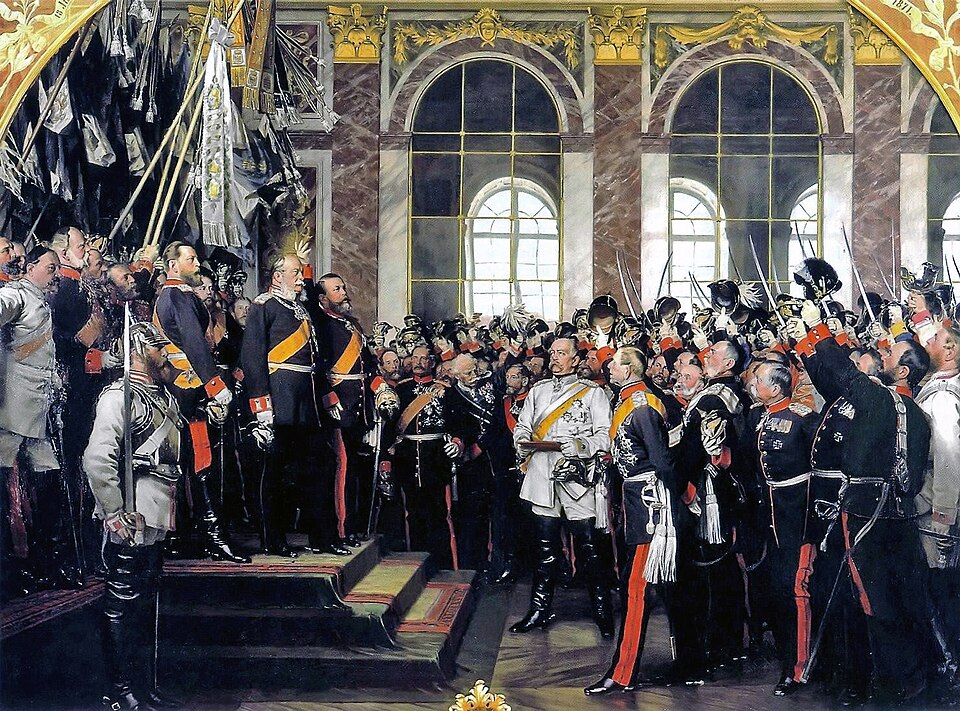
In the summer of 1870, France still believed itself the master of continental Europe. That belief had been shaken in 1866, when Prussia crushed Austria in a swift war and began knitting the German states together under its own banner. Empress Eugénie, Foreign Minister Drouyn de Lhuys, and War Minister Jacques Louis Randon had watched nervously, urging Napoleon III to mass troops on the eastern border as a warning. He did not. Instead, French diplomacy turned to demands: the return of the 1814 borders, the annexation of Luxembourg, most of the Saarland, and the Bavarian Palatinate. Prussian chancellor Otto von Bismarck dismissed this as France's 'politique des pourboires' — a tipping policy — and used the demands to draw the southern German states of Baden, Württemberg, Bavaria, and Hesse-Darmstadt into defensive alliances with Prussia.
The spark came from Spain. When Prince Leopold of Hohenzollern-Sigmaringen was offered the vacant Spanish throne in 1870, France saw a Hohenzollern encirclement in the making. The French ambassador confronted Prussian King Wilhelm I at his vacation retreat in Ems, demanding Prussia renounce any future claim to the throne. Wilhelm refused. An internal account of the meeting, the Ems dispatch, reached Berlin on 13 July. Bismarck rewrote it before releasing it to the press, sharpening its tone into something that read as a mutual insult.
On 14 July — France's national holiday — French newspapers printed Bismarck's version, without their own ambassador's report to balance it. Crowds filled the streets of Paris demanding war. French mobilization followed swiftly, and on 15 July France mobilized its army; the North German Confederation answered with its own mobilization that same day. On 16 July, the French parliament voted to declare war, and by 19 July it was official. Historians still debate whether Bismarck engineered the whole crisis to unite Germany against a common enemy, or simply seized the moment as it unfolded — but all agree he recognized the opportunity the instant it appeared.
France struck first, crossing into German territory on 2 August. But the German coalition mobilized far faster and more efficiently, using railways to move troops with a precision the French could not match. By 4 August, German forces were pushing into northeastern France. The French army, some 400,000 strong and veterans of Crimea, Algeria, and Mexico, carried the Chassepot rifle — a breech-loading weapon effective to nearly 1,500 metres. But numbers told: Prussia and its allies could field over a million men, thanks to universal conscription, and their Krupp steel breech-loading artillery outranged and outgunned the French guns.
The war's turning point came in eastern France. A string of hard-fought German victories culminated in the Siege of Metz and the Battle of Sedan, where Emperor Napoleon III himself was captured along with his army. The Second Empire's military power was shattered in a single stroke. In Paris, a Government of National Defense formed on 4 September, refusing to accept defeat, and the war ground on for five more months as German forces defeated newly raised French armies across northern France.
More from History

The Morning Bingham Climbed to Machu Picchu
On a cold July morning in 1911, an American historian scrambled up a jungle-choked ridge above the Urubamba River — and by afternoon, a forgotten Inca citadel would belong to the world.

The Last Half-Hour of the Hindenburg
It was already half a day late, and the public had been told to keep away — but at seven o'clock that evening, the Hindenburg finally turned toward its mooring mast for the last time.

The Last Hours of Pompeii: August 24, 79 AD
By noon it was just another hot day beside the Bay of Naples. By evening, an entire mountain had rewritten the fate of thousands.

The Longest Walk: Mandela's Last Steps to Freedom
After 27 years behind bars, a 71-year-old man had to relearn how to walk out of a prison gate — into a waiting world of cameras, crowds, and a country holding its breath.

The Document Lincoln Signed on the First Day of 1863
On a single January morning, a president's pen would change the legal status of more than three million people — if the ink held and his hand did not shake.

The Day of the Dream: August 28, 1963
Two hundred and fifty thousand people converged on the National Mall that morning — by nightfall, one voice from the steps of the Lincoln Memorial would echo for generations.