The Wave That Moved at 35 Miles an Hour
At half past noon on a mild January day, Boston's North End heard a sound like machine-gun fire — and then the street turned to syrup.
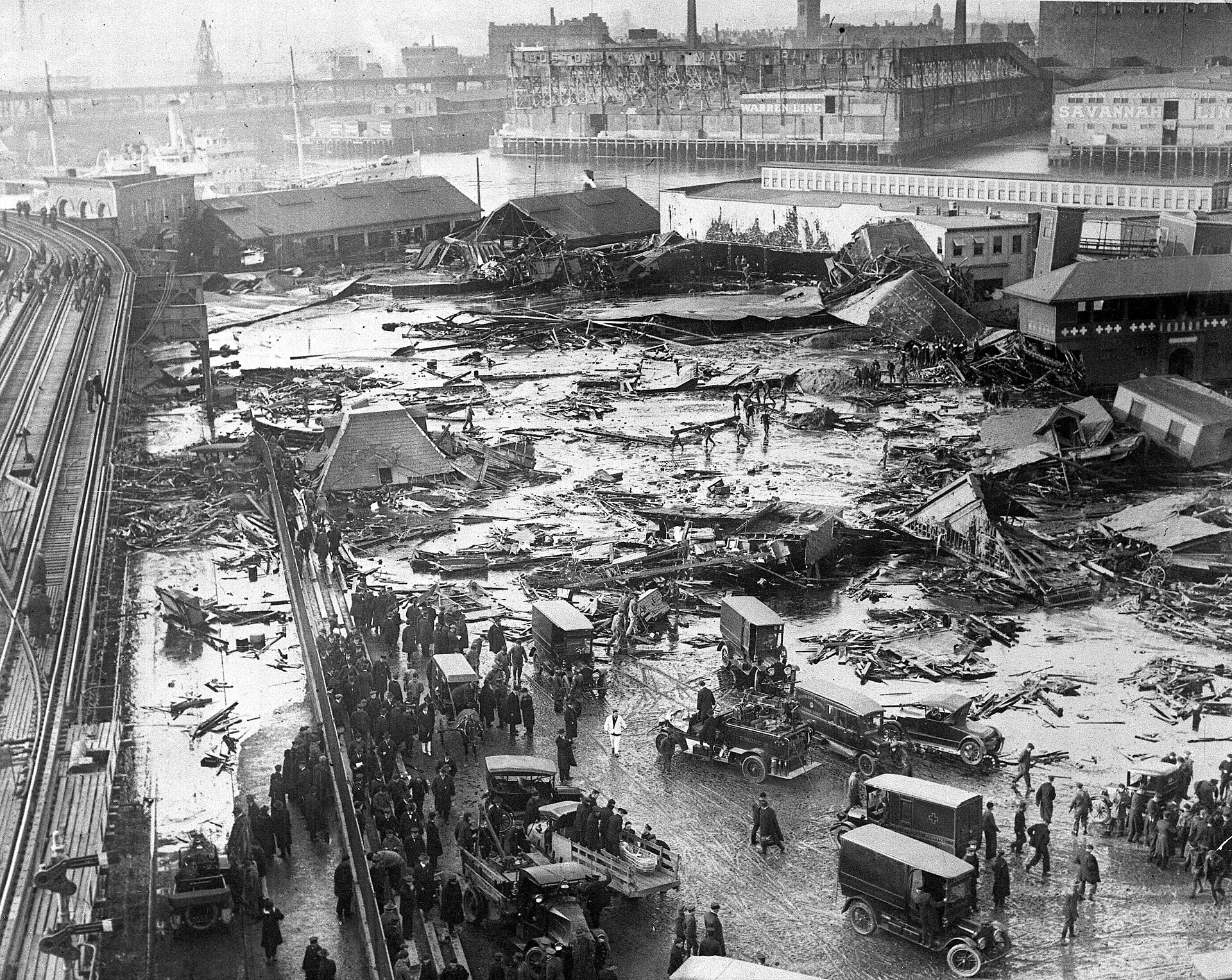
By the morning of January 15, 1919, the bitter cold that had gripped Boston for days had broken. Temperatures climbed past 40 degrees Fahrenheit, a welcome thaw in the North End, where dockworkers, teamsters, and children moved along Commercial Street near Keany Square as they did any other winter day. Looming over them was a steel tank belonging to the Purity Distilling Company: 50 feet tall, 90 feet across, holding as much as 2.3 million gallons of molasses, destined to be piped to an ethanol plant in Cambridge. The day before, a ship had unloaded a fresh, warmed batch of molasses into the tank, mixing with the older, colder syrup already inside.
Just before 12:30 in the afternoon, something inside the tank gave way. Witnesses felt the ground shake. There was a deep, machine-gun-like rattle as rivets shot from the steel plates, followed by a sound like a passing elevated train, or a thunderclap. The tank's walls tore open and collapsed outward.
What followed was not water but something far heavier — molasses is roughly 40 percent denser than water, and the sheer weight of 13,000 tons crashing down turned into a wave 25 feet high, surging through the streets at an estimated 35 miles per hour. The force was enough to bend steel panels against the girders of the Boston Elevated Railway's Atlantic Avenue structure and briefly lift a streetcar off its tracks.
Buildings near the tank were knocked clean off their foundations, crushed by the advancing wall of syrup. Within moments, several blocks stood flooded two to three feet deep in molasses. A truck was said to have been picked up by the rush of air the wave displaced and hurled into the harbor. People near the tank were reportedly thrown feet into the air by that same displaced air, with debris flung alongside them.
More from History

The Morning Bingham Climbed to Machu Picchu
On a cold July morning in 1911, an American historian scrambled up a jungle-choked ridge above the Urubamba River — and by afternoon, a forgotten Inca citadel would belong to the world.

The Last Half-Hour of the Hindenburg
It was already half a day late, and the public had been told to keep away — but at seven o'clock that evening, the Hindenburg finally turned toward its mooring mast for the last time.

The Last Hours of Pompeii: August 24, 79 AD
By noon it was just another hot day beside the Bay of Naples. By evening, an entire mountain had rewritten the fate of thousands.

The Longest Walk: Mandela's Last Steps to Freedom
After 27 years behind bars, a 71-year-old man had to relearn how to walk out of a prison gate — into a waiting world of cameras, crowds, and a country holding its breath.

The Document Lincoln Signed on the First Day of 1863
On a single January morning, a president's pen would change the legal status of more than three million people — if the ink held and his hand did not shake.

The Day of the Dream: August 28, 1963
Two hundred and fifty thousand people converged on the National Mall that morning — by nightfall, one voice from the steps of the Lincoln Memorial would echo for generations.