Tiananmen Square: The Man Before the Tank
A gate built for emperors became the largest public square on Earth — and then, one June morning, the stage for one of the twentieth century's most haunting standoffs.
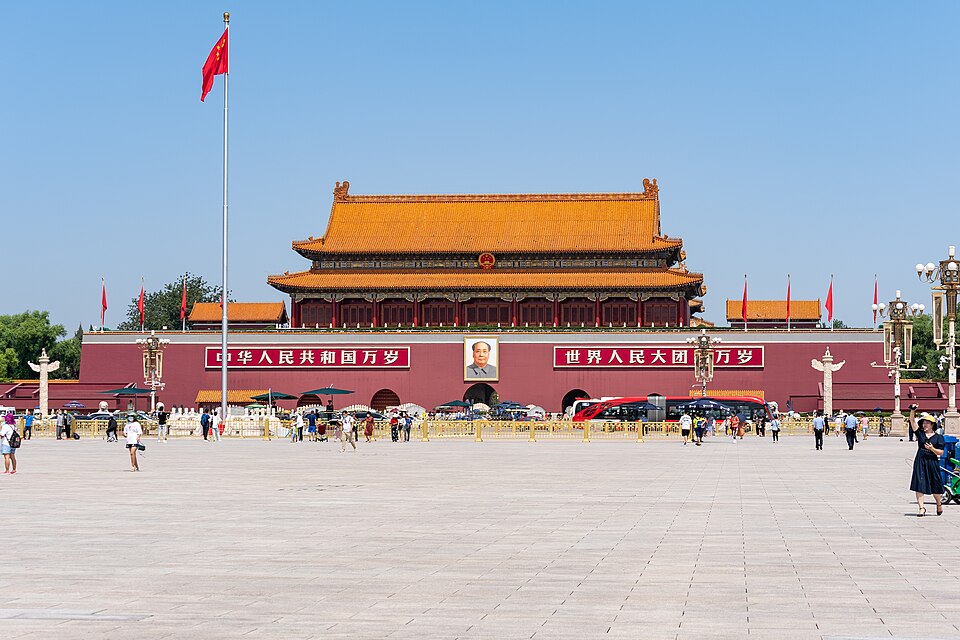
At the heart of Beijing, where the Forbidden City meets the modern capital, stands a gate first raised in 1417: the Tiananmen, or 'Gate of Heavenly Peace.' For centuries it marked the ceremonial threshold between the emperor and his subjects, a passage so sacred that ordinary traffic was diverted to side gates while commoners built a bustling marketplace nearby, nicknamed the 'Chess Grid Streets.'
The gate did not escape the violence of empire. In the seventeenth century, fighting between the rebel forces of Li Zicheng and the Manchu-led Qing dynasty left it heavily damaged. It was rebuilt in 1651, the year the square itself took shape. Foreign armies later left their mark too: in 1860, British and French troops occupying Beijing during the Second Opium War camped near the gate and briefly debated burning it down alongside the Forbidden City, before choosing to destroy the Old Summer Palace instead. Four decades later, the Eight-Nation Alliance battered the surrounding offices during the Boxer Rebellion.
The square's true transformation came under Mao Zedong. On October 1, 1949, he stood at the gate and proclaimed the founding of the People's Republic of China, an anniversary still marked there today. In 1954 the old Gate of China was torn down to make room, and in November 1958 a massive expansion began, completed by August 1959 after roughly eleven months of work. Mao wanted the largest, most spectacular square in the world — one built to hold over 500,000 people. Entire residential blocks vanished to make it happen. The Monument to the People's Heroes rose on its southern edge, while the Great Hall of the People and what is now the National Museum of China flanked it east and west, part of the 'Ten Great Buildings' marking the PRC's tenth anniversary.
For years, the square doubled as a stage for state theater. Military parades once marked every National Day, echoing Soviet celebrations of the Bolshevik Revolution, before costs forced smaller annual events with grand parades only every decade. In 1971, giant portraits of Marx, Engels, Lenin, Stalin, Sun Yat-sen, and Mao appeared across the square, painted by artist Ge Xiaoguang — the same man behind the iconic Mao portrait still hanging over the gate today. After Mao's death, as political fervor cooled, those portraits were retired, brought out only on Labor Day and National Day.
Today the square measures 765 by 282 meters, a vast concrete expanse where a national flag rises and falls with the sun each day. In 2024, it was inscribed as a UNESCO World Heritage Site as part of Beijing's Central Axis, its imperial gate and revolutionary monuments now framed as heritage rather than propaganda.
More from History

The Morning Bingham Climbed to Machu Picchu
On a cold July morning in 1911, an American historian scrambled up a jungle-choked ridge above the Urubamba River — and by afternoon, a forgotten Inca citadel would belong to the world.

The Last Half-Hour of the Hindenburg
It was already half a day late, and the public had been told to keep away — but at seven o'clock that evening, the Hindenburg finally turned toward its mooring mast for the last time.

The Last Hours of Pompeii: August 24, 79 AD
By noon it was just another hot day beside the Bay of Naples. By evening, an entire mountain had rewritten the fate of thousands.

The Longest Walk: Mandela's Last Steps to Freedom
After 27 years behind bars, a 71-year-old man had to relearn how to walk out of a prison gate — into a waiting world of cameras, crowds, and a country holding its breath.

The Document Lincoln Signed on the First Day of 1863
On a single January morning, a president's pen would change the legal status of more than three million people — if the ink held and his hand did not shake.

The Day of the Dream: August 28, 1963
Two hundred and fifty thousand people converged on the National Mall that morning — by nightfall, one voice from the steps of the Lincoln Memorial would echo for generations.