Twelve Seconds That Changed the Sky
On a windswept dune in North Carolina, a spindly machine of spruce and cotton lifted off the sand for twelve seconds — and the age of flight began.
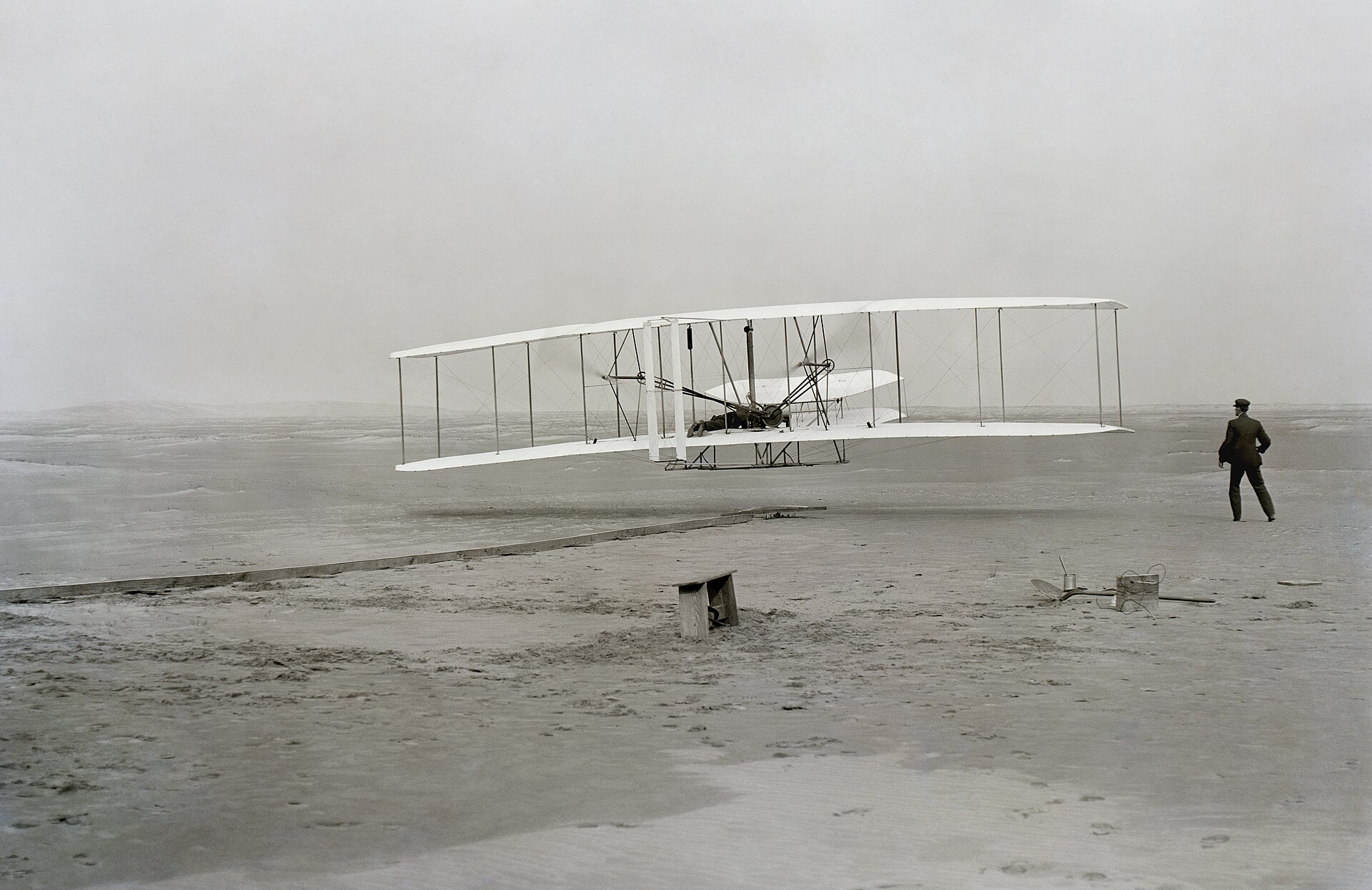
On the morning of December 17, 1903, five witnesses stood on the cold sand of Kill Devil Hills, near Kitty Hawk, North Carolina, watching two bicycle mechanics from Dayton, Ohio, prepare to do something no one had ever done before. Orville and Wilbur Wright had spent three years testing gliders on these dunes, drawn by a meteorological office's assurance that the wind here blew hard and steady. Their 1902 Glider had taught them how to control an aircraft in the air; now they needed only power.
That power came from an engine built by their employee Charlie Taylor, who in six weeks had fashioned a 12-horsepower, 180-pound gasoline engine from a block of cast aluminum, with cast-iron pistons and no carburetor in the modern sense — fuel dripped by gravity from a one-gallon tank into a shallow chamber, ignited by contact points rather than spark plugs. Two hand-carved spruce propellers, connected by bicycle-style chains (one deliberately crossed to spin the blades in opposite directions and cancel torque), pushed the aircraft forward from behind.
The Flyer itself was a canard biplane: double elevator at the front, double rudder at the back, wings spanning just over 40 feet and covered in a tightly woven cotton muslin called Pride of the West — the same fabric used for women's undergarments. It weighed 605 pounds empty, and it had no seat; the pilot lay flat on his stomach on the lower wing, steering by shifting his hips in a cradle that pulled wires to warp, or twist, the wings for balance.
Getting here had taken persistence. On November 5, engine tests had loosened the propeller hubs. The shafts were shipped back to Dayton for repair, returned on November 20, only for a hairline crack to appear in one of them. Orville went home again on November 30 to forge new shafts from spring steel. By December 12 the repaired Flyer was tested on its 60-foot wooden launching rail — and three days later, on December 14, a first attempt lasted just 3.5 seconds before the aircraft stalled and came down.
More from History

The Morning Bingham Climbed to Machu Picchu
On a cold July morning in 1911, an American historian scrambled up a jungle-choked ridge above the Urubamba River — and by afternoon, a forgotten Inca citadel would belong to the world.

The Last Half-Hour of the Hindenburg
It was already half a day late, and the public had been told to keep away — but at seven o'clock that evening, the Hindenburg finally turned toward its mooring mast for the last time.

The Last Hours of Pompeii: August 24, 79 AD
By noon it was just another hot day beside the Bay of Naples. By evening, an entire mountain had rewritten the fate of thousands.

The Longest Walk: Mandela's Last Steps to Freedom
After 27 years behind bars, a 71-year-old man had to relearn how to walk out of a prison gate — into a waiting world of cameras, crowds, and a country holding its breath.

The Document Lincoln Signed on the First Day of 1863
On a single January morning, a president's pen would change the legal status of more than three million people — if the ink held and his hand did not shake.

The Day of the Dream: August 28, 1963
Two hundred and fifty thousand people converged on the National Mall that morning — by nightfall, one voice from the steps of the Lincoln Memorial would echo for generations.